
Technical Specifications
|
No. |
Parameter |
Specification |
|
1 |
Laser Wavelength |
905 nm ± 5 nm |
|
2 |
Laser Beam Divergence |
< 6 mrad |
|
3 |
Optical Material |
Resin aspheric lens |
|
4 |
Receiver Aperture |
9.2 mm × 14.5 mm |
|
5 |
Ranging Range |
4m – 1000 m |
|
6 |
Ranging Accuracy |
±1 m¹) (≤ 500 m) |
|
7 |
Ranging Frequency |
3 Hz – 10 Hz, adaptive |
|
8 |
Valid Measurement Rate |
≥ 98% |
|
9 |
False Alarm Rate |
≤ 1% |
|
10 |
Communication Interface |
UART-TTL, customizable |
|
11 |
Baud Rate |
115200 bps |
|
12 |
Supply Voltage |
3.3 V – 5 V |
|
13 |
Startup Time |
≤ 200 ms |
|
14 |
Startup Inrush Current |
≈ 350 mA |
|
15 |
Sleep Power Consumption |
< 1 mW |
|
16 |
Standby Power Consumption |
< 0.3 W |
|
17 |
Near-Range Power Consumption |
< 0.5 W |
|
18 |
Long-Range Power Consumption |
< 1.2 W |
|
19 |
Operating Temperature |
−20 °C to +55 °C (−40 °C optional) |
|
20 |
Storage Temperature |
−40 °C to +60 °C |
|
21 |
Protection Rating |
IP67 (inside lens cavity) |
|
22 |
Laser Safety Class |
IEC Class 1 |
|
23 |
Dimensions |
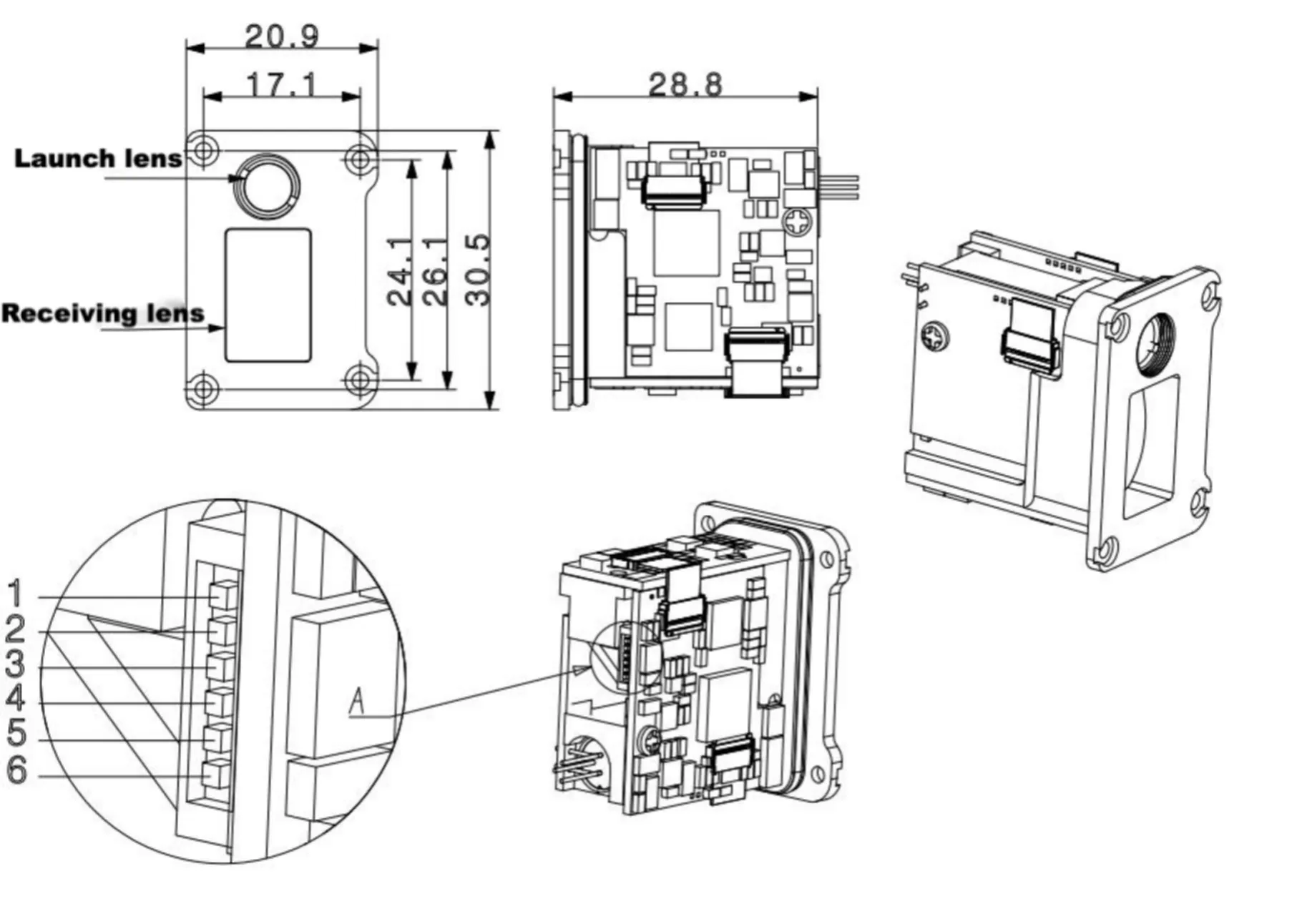
28.8mm*30.5mm*20.9mm (square) |
|
24 |
Weight |
≤ 16 g |
|
25 |
Shock |
1000 g/ms (10 times/s along the optical axis) |
|
26 |
Vibration |
5–50–5 Hz, 1 octave/min, 2.5 g |
|
27 |
Reliability |
MTBF ≥ 1500 h |
Notes:
1)The target size is 2.3m × 2.3m with a reflectivity of 90%.
2) The target size is 2.3m × 4.6m with a reflectivity of 90%.
3) The accuracy indicated in the table is the accuracy for the white board.
Functional Description
The system supports single measurement and continuous measurement modes.
1 External Circuit Enable
Enables the module for normal operation.
2 External Circuit Disable
Disables the external circuit to reduce power consumption.
3 Single Measurement
Triggers a single distance measurement to the target. For low-reflectivity targets, the system automatically performs repeated measurements until stable distance data is obtained. The final result is transmitted via the serial interface in the standard data format.
4 Continuous Measurement
In continuous measurement mode, the laser module performs repeated distance measurements on the target. The typical refresh rate is set to 2 Hz or 5 Hz, and the maximum refresh rate can reach 30 Hz (customized version required). The refresh rate can be adjusted via the serial interface.
Electrical Interface Definition
|
Pin |
Definition |
Description |
|
1 |
GND |
Power − |
|
2 |
VCC |
Power + |
|
3 |
I/O(Reserved) |
Reserved for expansion |
|
4 |
TXD |
Signal output port, Ranging Module → Host |
|
5 |
RXD |
Signal input port, Host → Ranging Module |
|
6 |
SW-SHOT |
Function Enable (active high) Note: Compatible with active-low control requirements |
Mechanical Interface
 Product Description
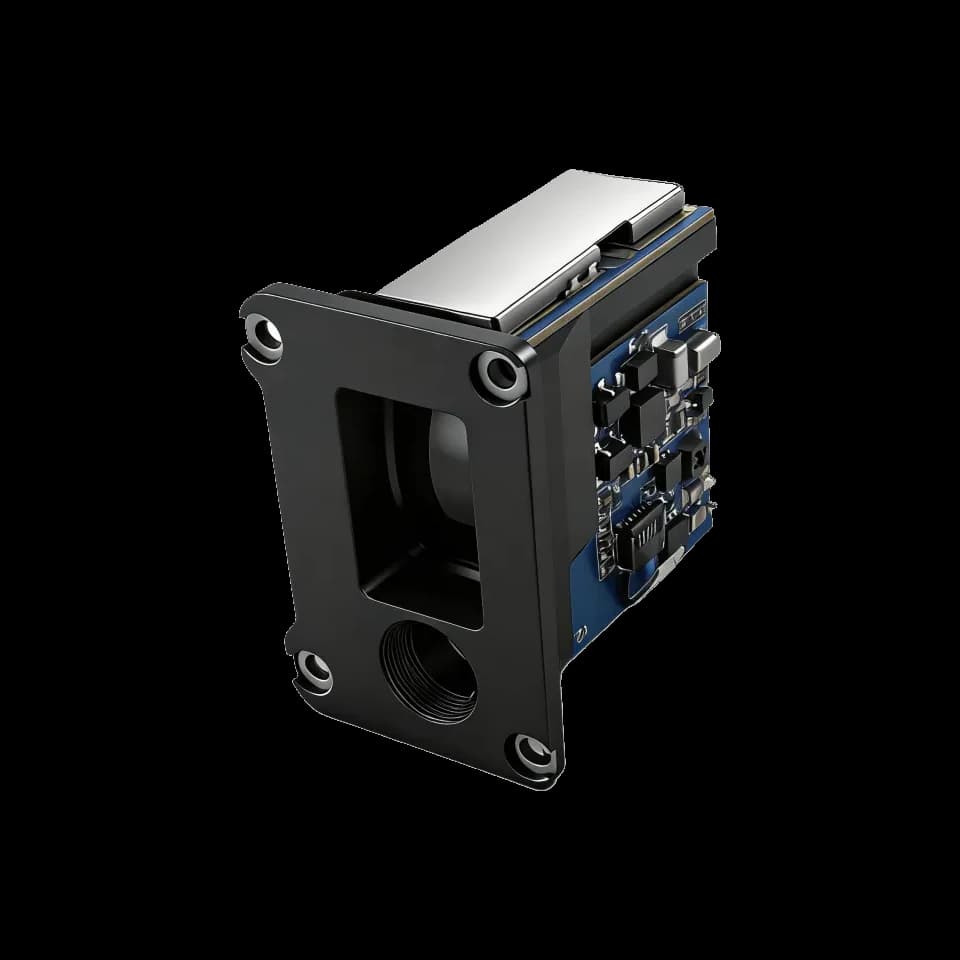
The LR1000C4 is a new-generation 905nm compact laser rangefinder module developed for OEM integration in night vision devices, thermal imagers, telescopes, laser illuminators and lightweight UAV payloads. It is positioned as a civil-use electro-optical ranging core rather than a large Professional fire-control unit, focusing on compact size, low power and straightforward serial integration.
The module operates at 905nm ±5nm and provides a ranging capability of 4m to 1000m. According to the specification, ranging accuracy is ±1m for distances up to 500m, and ±1m + d×0.1% from 500m to 1000m, where d is the measured distance. The valid measurement rate is ≥98%, the false alarm rate is ≤1%, the laser beam divergence is <6mrad, and the receiver aperture is 9.2mm × 14.5mm. These numbers place the LR1000C4 squarely in the class of compact 905nm OEM rangefinder modules commonly integrated into handheld optics and small electro-optical payloads.
A practical strength of the LR1000C4 is its adaptive 3–10Hz ranging frequency. The module supports both single measurement and continuous measurement, and the manual notes that for low-reflectivity targets, single-shot mode will automatically repeat internally until stable distance data is obtained before sending the result over the serial interface. In continuous mode, the typical refresh rate is 2Hz or 5Hz, while 30Hz is available as a customised version. That makes the sensor suitable for observation devices that need a stable reading first, rather than brute-force high-rate output all the time.
Electrically, the LR1000C4 uses a UART-TTL interface with a default baud rate of 115200bps and a supply voltage of 3.3V–5V. Startup time is ≤200ms, startup inrush current is approximately 350mA, sleep power is <1mW, standby power is <0.3W, near-range power is <0.5W, and long-range power is <1.2W. That gives it a strong SWaP profile for portable optics, low-power field systems and compact airborne payloads. Comparable 905nm modules on the market are also commonly positioned around handheld optics, night vision, thermal imaging and UAV payload integration, which matches the LR1000C4’s niche quite well.
The communication format is simple and firmware-friendly. The module uses an 8-byte frame with 0x55 0xAA header bytes, a function code, four data bytes and checksum. Supported functions include single-shot ranging, continuous ranging, stop ranging, optional angle measurement for versions fitted with an angle sensor, power-on self-test, baud-rate configuration and LD constant-ON mode for development. Distance data is returned in hexadecimal as the actual value multiplied by 10, so the host can reconstruct the range with one decimal place. The manual also notes that the baud-rate change only takes effect after reboot, and that LD constant-ON mode should not be kept enabled for long periods.
Mechanically, the LR1000C4 adopts a 28.8mm × 30.5mm × 20.9mm square format and weighs ≤16g, which clearly separates it from cylindrical 905nm modules intended for different packaging styles. It is specified for −20°C to +55°C operating temperature, with a −40°C optional version, −40°C to +60°C storage, IP67 protection inside the lens cavity, 1000g/ms shock and 5–50–5Hz, 2.5g vibration, with MTBF ≥1500h. Those specifications make it attractive for rugged civil electro-optical equipment used outdoors.
For optical window integration, the manual recommends H-K9L optical glass or fused silica, a wedge-angle tolerance of ≤3′, surface roughness around Ra 0.012, and an AR coating optimised for 855–955nm with transmittance ≥99.5%. After any hydrophobic or hard coatings, total transmittance should remain ≥98%. The guide also recommends keeping the optical-window thickness around 2–4mm, the transmit optical axis parallel to the window normal, and the air gap below 0.5mm to limit additional loss and back-reflection. It is gloriously unromantic engineering, which is usually where the real range performance lives.
The usage notes also clarify real-world ranging behaviour. Reflectivity, target shape, incidence angle and weather all affect effective range and response time. Under the specified reference condition—a medium-reflectivity target such as a building wall, perpendicular incidence, clear weather and no direct sunlight—the module achieves its nominal performance. The manual adds that high-reflectivity targets may reach about 1500m, while low-reflectivity targets may only reach about 600m; rain, fog, snow and haze will reduce usable distance, and tripod mounting is recommended for long-distance measurement.
Taken together, the LR1000C4 is best understood as a compact 905nm laser rangefinder module for civil electro-optical integration: small enough for handheld and embedded devices, powerful enough for 1km-class ranging, and simple enough for quick UART-based secondary development in night vision, thermal imaging, portable optics, UAV payloads and outdoor observation systems.