
Carrinho

O seu carrinho de compras está vazio.

Ir às compras

Working Principle and Typical Applications of Fast Steering Mirror (FSM)

24 de jul. de 2025 Erdicn
Working Principle and Typical Applications of Fast Steering Mirror (FSM)

I. Working Principle of Fast Steering Mirror (FSM)
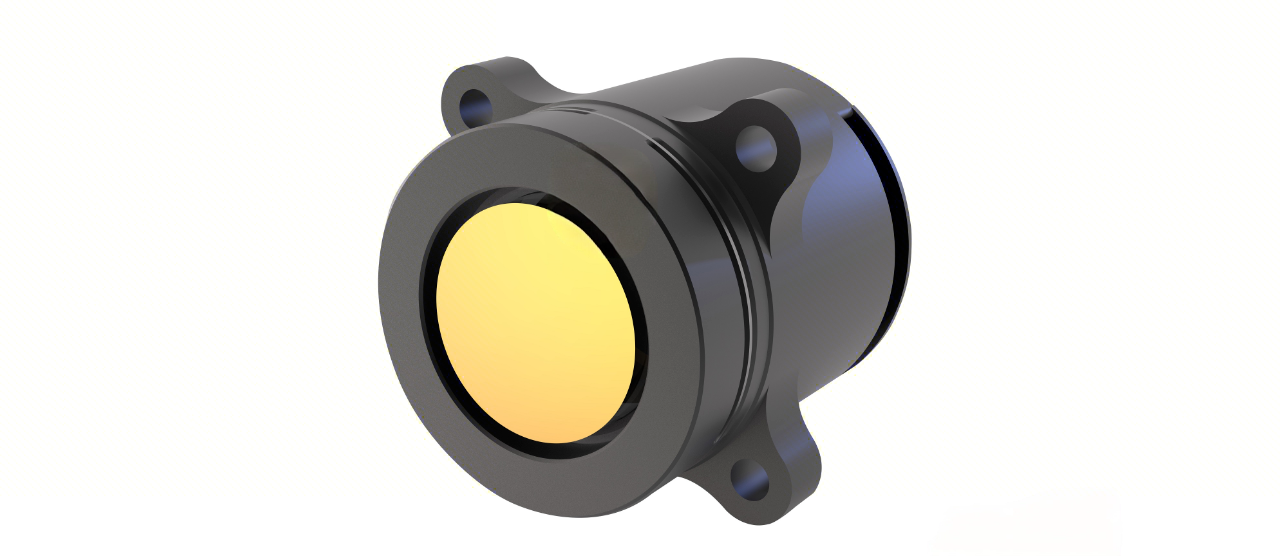
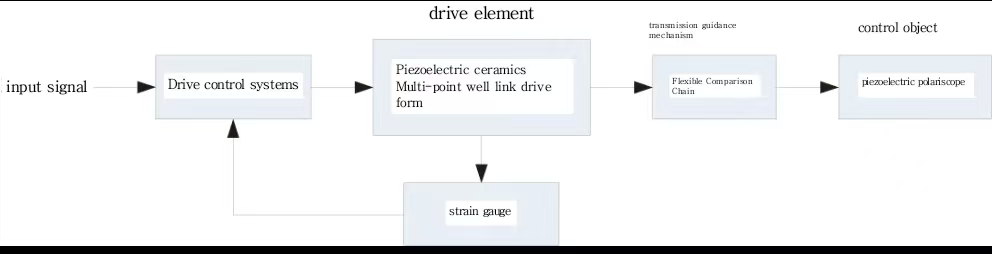
The fast steering mirror adopts a composite structure of piezoelectric ceramic drive + flexible hinge transmission, with main components including:
  • Drive Unit: Piezoelectric ceramics (achieving nanometer-level displacement using the inverse piezoelectric effect).
  • Transmission Mechanism: Flexible hinges (no mechanical friction, transmitting motion through elastic deformation).
  • Feedback Unit: Strain gauges or capacitive sensors (full closed-loop control accuracy reaching the μrad level).
  • Reflective Mirror: Made of fused quartz or silicon carbide (surface profile accuracy ≤ λ/4 RMS).

Taking a four-point driven fast steering mirror as an example, the schematic diagram of the two-dimensional worktable is as follows. A, B, C, and D are all piezoelectric ceramic actuators, and the four driving elements of this fast tilting mirror are evenly distributed at 90° in the XY plane.
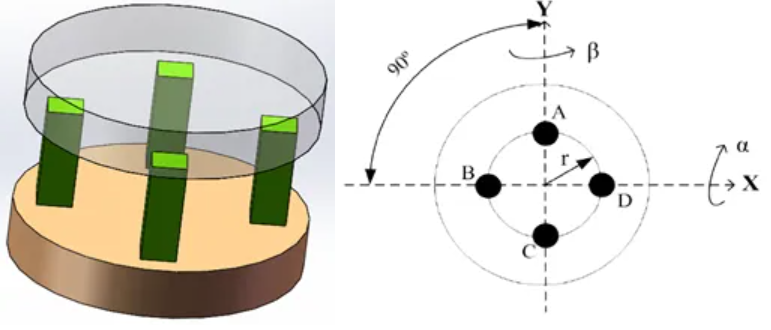
The tilting mirror operates by using the inverse piezoelectric effect of piezoelectric ceramics to drive the tilting mirror plate. During operation, a voltage is applied to the piezoelectric ceramics through a controller, causing them to extend or contract. When the extension amount is approximately half of their maximum displacement, the mirror position of the deflection platform at this moment is taken as the reference plane. The control voltages at both ends of piezoelectric ceramics A and C remain unchanged, while the control voltages of the two piezoelectric ceramics B and D installed along the X-axis are adjusted, causing one of the piezoelectric ceramics to extend and the other to contract. The movement of the two piezoelectric ceramics is transmitted through the elastic deformation of the flexible ring, thereby achieving the deflection movement of the deflection platform around the Y-axis. By the same principle, the deflection of the tilting mirror around the X-axis can be realized.

II. Application Fields of Fast Steering Mirror (FSM)

As a core device for high-precision laser micro-motion control, the fast steering mirror (FSM) plays a critical role in cutting-edge fields such as laser communication, beam alignment, adaptive optics, super-resolution imaging, optical image stabilization, image motion compensation, and precision laser processing. It leverages its nanosecond-level fast response capability, sub-microradian-level angular resolution, and dynamic stability. Its core advantage lies in the synergistic effect of large bandwidth and high-frequency response control capabilities with nanometer-level positioning accuracy, enabling efficient decoupling of the output images of optoelectronic sensors from the disturbances of moving carriers. The stabilization accuracy can reach within ±2 μrad (typical value).

1. Laser Communication (ATP Technology)

In laser communication (Free Space Optical Communication, FSO), FSM is used in Acquisition, Tracking, and Pointing (ATP) systems to compensate for beam drift and ensure the stability of inter-satellite/air-ground communication links. Compared with traditional microwave communication technologies, this technical system exhibits significant advantages:


  • Bandwidth Advantage: The information capacity is several times higher than that of microwave communication.
  • Power Consumption Optimization: The terminal power consumption is ≤30 W (average value), suitable for satellite platforms.
  • Anti-Interference Capability: With a μrad-level image stabilization accuracy, it suppresses atmospheric turbulence and carrier jitter.

2. Image Stabilization System Applications

  • Dynamic Image Stabilization: In airborne/vehicle-borne optoelectronic systems, high-frequency deflection compensates for platform vibrations, achieving an image stabilization accuracy with a 5 ms step response.
  • Optical Path Calibration: Corrects beam tilt errors in laser processing equipment to improve processing consistency.

3. Astronomical Observation

  • Telescope Pointing Stabilization: Real-time correction of low-frequency aberrations caused by atmospheric disturbances to enhance observation resolution.

III. Typical Manufacturers: Technical Routes and Product Comparisons

1. Internationally Leading Enterprises

  • Physik Instrumente (Germany): A representative manufacturer of piezoelectric fast steering mirrors (FSMs), renowned for products with nanometer-level resolution and kilohertz-level bandwidth, such as the S-340 series.
  • Raytheon (USA): A technology leader in voice coil motor-driven FSMs, whose Responder series offers a deflection angle of ±10 mrad, suitable for space laser communication.

2. Core Chinese Manufacturers

  • Sanying Precision Control: Specializing in piezoelectric drive technology, its NS-RB series FSMs achieve a closed-loop resolution of 0.1 μrad, adapted for lidar and satellite communication scenarios.
  • Dianhui Technology: Develops voice coil motor-driven products (e.g., FSM-720 series) supporting ±1.5° mechanical deflection, applied in optical image stabilization and laser processing. If you encounter confusion in FSM selection, feel free to jump to read Dianhui Technology’s series of articles to easily master the key points of model selection.
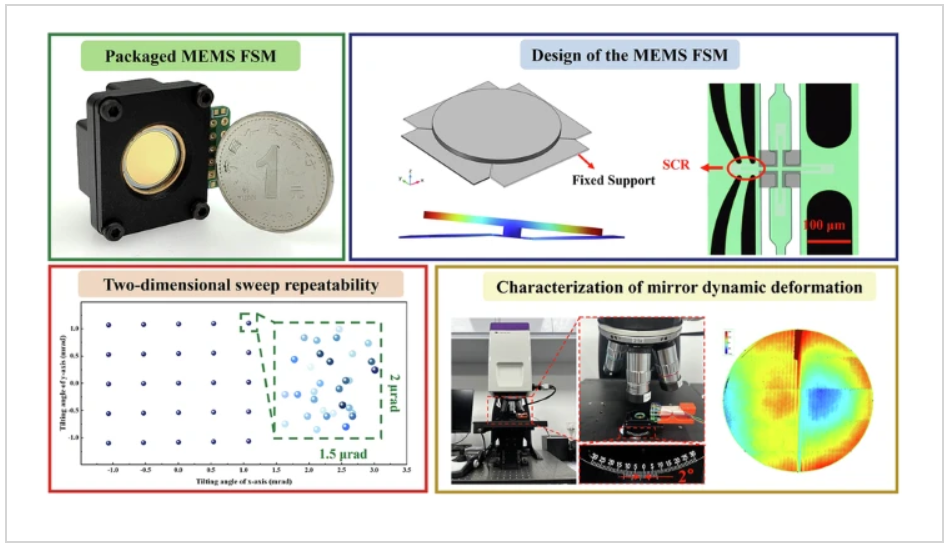
  • Shanghai Institute of Microsystem and Information Technology, Chinese Academy of Sciences: Successfully developed a 10-mm large-aperture piezoelectric MEMS (Micro-Electro-Mechanical System) fast steering mirror.

Conclusion

As the “nerve center” of precision optical systems, fast steering mirror (FSM) technology will deeply penetrate into emerging fields such as communications and quantum sensing in future development. The iterative evolution of this technology not only demonstrates breakthroughs in the technical limits of precision optoelectromechanical systems but will also become a model for interdisciplinary innovation between optical engineering and information science.
Voltar ao título do blog

Postar comentário

Observe que os comentários precisam ser aprovados antes de serem publicados.