
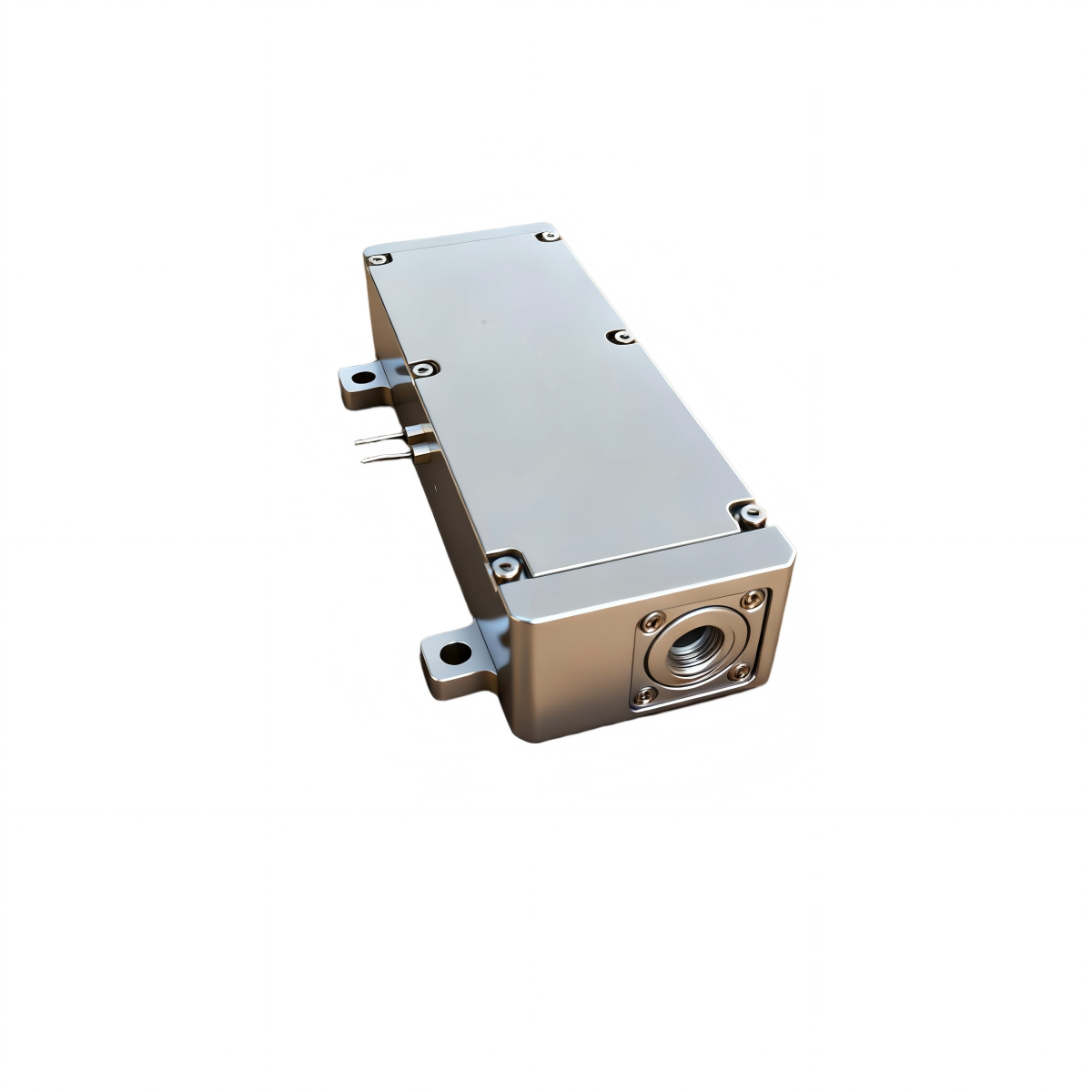
Q-switched Nd:YAG lasers are solid-state sources designed to generate short, high-peak-power optical pulses. Instead of releasing energy continuously, the laser stores energy in the gain medium and rapidly switches the resonator from a low-quality to a high-quality state. The stored energy is then emitted as a nanosecond-scale pulse.
How Q-switching works
The Q-switch controls loss inside the optical resonator. During the energy-storage period, the resonator suppresses laser oscillation while the Nd:YAG crystal is pumped. When the switch opens, the stored energy is released in a short pulse. The exact pulse energy, pulse width, and repetition rate depend on the gain medium, pump source, cavity design, Q-switch type, and thermal conditions.
1064 nm output and harmonic wavelengths
Nd:YAG lasers commonly operate at 1064 nm. Nonlinear crystals can convert part of that output to harmonic wavelengths such as 532 nm, but conversion changes efficiency, beam characteristics, thermal behavior, and optical-coating requirements. System designers should specify the wavelength required by the detector, target, atmosphere, and downstream optics.
Key parameters for system integration
- Pulse energy and pulse width: determine peak power and interaction with the target.
- Repetition rate and timing jitter: affect update rate, synchronization, and measurement stability.
- Beam divergence and beam quality: influence spot size and usable range.
- Trigger interface: must match the host controller and required timing sequence.
- Power and thermal design: should account for peak current, average dissipation, warm-up, and duty cycle.
- Package and optical alignment: must remain stable across temperature, shock, and vibration.
Applications beyond medical and cosmetic systems
Q-switched Nd:YAG sources are used in laser ranging, target designation, LiDAR, material marking, micromachining, nonlinear-optics experiments, spectroscopy, and calibration systems. Each application requires a different balance of pulse energy, repetition rate, beam quality, lifetime, and environmental performance.
Safety and validation
High-peak-power 1064 nm radiation is invisible and can present serious eye and skin hazards. The integrated product requires appropriate enclosures, interlocks, warning labels, operating procedures, and compliance testing. Module specifications do not replace a system-level laser-safety assessment.
ERDI TECH LTD develops pulsed 1064 nm laser designator and ranging modules for OEM integration. Our engineering team supports trigger-interface definition, beam-expander and optical-window integration, thermal design, and environmental validation.