
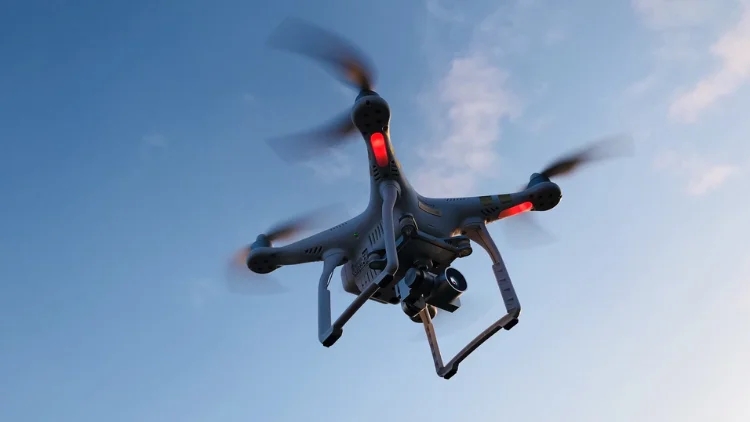
Tethered Drone
Tethered drone technology first entered the commercial sector in 2016 and is now regarded by many professionals as a crucial component of future military bases. As more and more fields adopt tethered drones to perform tasks, their market scale is expanding rapidly. The advancement of tethered drone technology has opened up brand new possibilities (brand-new possibilities) for scenarios such as aerial surveillance, border patrol, and temporary communication tower erection.
A tethered drone is a type of unmanned aerial vehicle (UAV) physically connected to a ground station. More specifically, it consists of a base station/power station (tethered station), a drone tether, and a specialized drone tethered to the station. The tethered base station (ground power supply station) can operate in remote or harsh environments, with its main functions including: providing power, converting energy, maintaining communication between the drone and the ground control station (GCS), and controlling the retraction and release of the tethered cable.
Micro-tethered cables are used to connect the drone to the ground station. They can not only fix the hovering position of the drone but also integrate conductors, optical fibers, and a broadband power line (BPL) dual-channel to support a dual communication link.
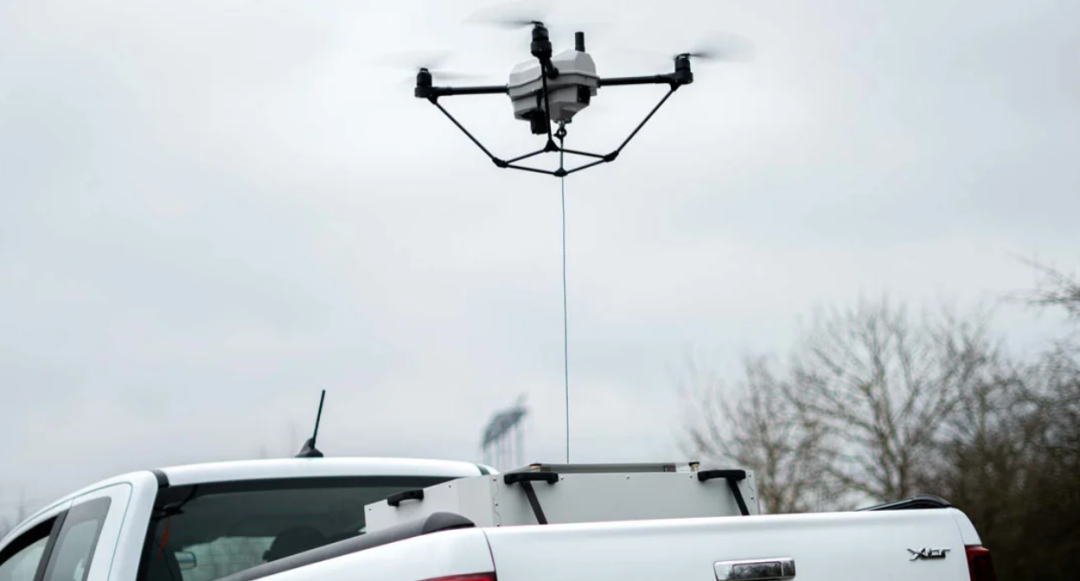
Advantages of Tethered Drones
To understand the value of tethered drones, it is necessary to compare the limitations of traditional free-flying drones (non-tethered drones):
Battery Life Limitations:
Free-flying drones have an average flight time of only 30 minutes and require frequent battery changes.
Tethered drones, however, can operate continuously for hours.
Inadequate Safety:
In dynamic scenarios such as festivals, disaster relief, or crowd monitoring, free-flying drones carry a high risk of losing control.
The tethered solution completely eliminates such hazards.
Operational Complexity:
Traditional drones require professional pilots for operation.
Tethered drones can take off with a single button and hover autonomously throughout the mission, allowing operators to focus more on task decision-making.
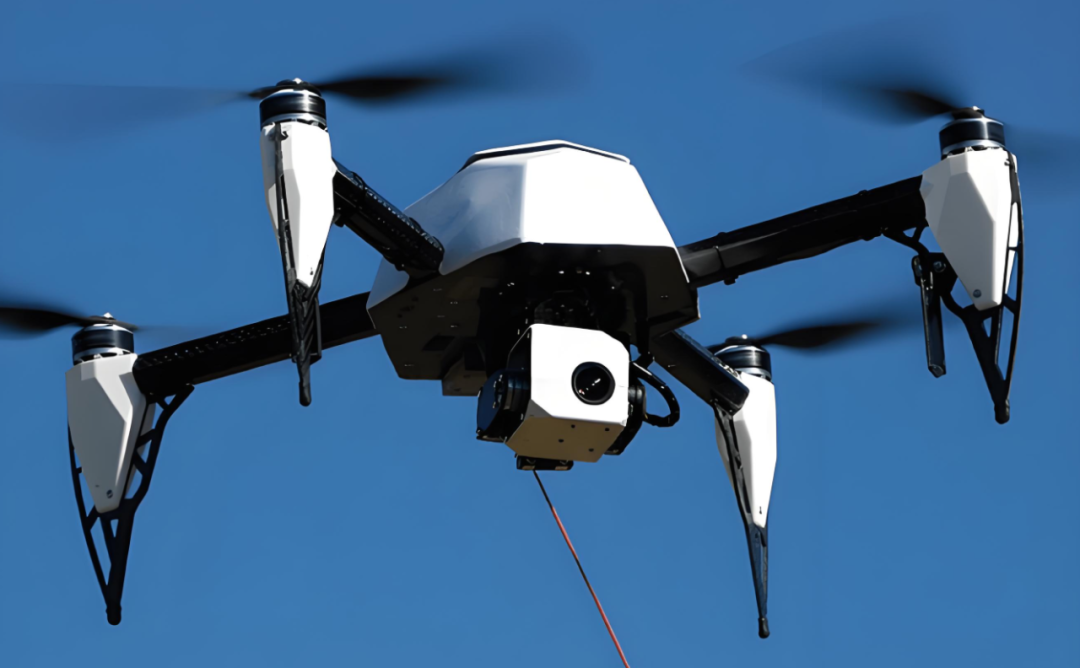
Core Advantages of Tethered Drones
Autonomy: Automated flight allows operators to focus on the task itself rather than control details.
Regulatory flexibility: Many countries treat it as “fixed equipment” rather than traditional drones, exempting registration requirements (e.g., the U.S. Federal Aviation Administration (FAA) explicitly permits its use).
Space constraints: Cables restrict the flight range to avoid the risk of out-of-control collisions.
Data security: Physical cables ensure stable communication and eliminate signal interruptions or data breaches.
Deterrence: Visible aerial monitoring equipment can effectively deter potential threats, with higher reliability than other security solutions.
Uses of Tethered Drones
1. Applications in the Defense Sector
Tethered drone technology is particularly suitable for border security and the protection of Forward Operating Bases (FOBs).
Border Surveillance
Traditional border security faces challenges due to complex geographical environments, the sensitivity of disputed territories, and illegal cross-border issues. Tethered drones can overcome physical barriers (such as walls and trenches) to provide continuous monitoring capabilities. For example, criminal groups often exploit porous borders for infiltration, but drones can cover key passages around the clock.
FOB Protection
Defending forward bases requires substantial manpower and equipment to address sporadic attacks, while fixed cameras have limited visibility. Tethered drones equipped with high-power optical zoom cameras can detect vehicles and large targets up to 10 kilometers away, with a coverage range far exceeding ground-based equipment. Their endurance can cover an 8-10-hour sentry rotation cycle, reducing security vulnerabilities.
Tactical Communications
Military drones are vulnerable to cyberattacks and anti-drone technology interference, while tethered cables provide physically encrypted communication links to block external penetration.
2. Civil and Public Security
Tethered drones also play a pivotal role in security for personnel and cargo in private and public areas, with their lightweight deployment and wide-area coverage capabilities serving as key advantages. Typical missions of tethered drones include event monitoring, perimeter protection, and crowd management, providing continuous aerial perspectives that significantly enhance situational awareness and emergency response efficiency. Additionally, in disaster-stricken areas, tethered drones can conduct real-time surveys of dangerous zones, locate trapped individuals, and establish temporary communication networks (supporting cellular networks, high-frequency radio, Wi-Fi, and 3G/4G signal coverage).
Tethered optoelectronic system
The photoelectric system is the “eye” of a tethered drone, and its main functions include:
Visible light imaging: High-definition cameras provide real-time images in daytime or well-lit environments.
Infrared thermal imaging: Detects heat sources (such as humans and vehicles) in nighttime or low-light environments, suitable for security and search-and-rescue operations.
Laser ranging/designation: Accurately measures the distance to targets or guides other equipment (such as weapon systems).
Multispectral/hyperspectral imaging: Analyzes vegetation, water quality, etc., in agricultural and environmental monitoring.
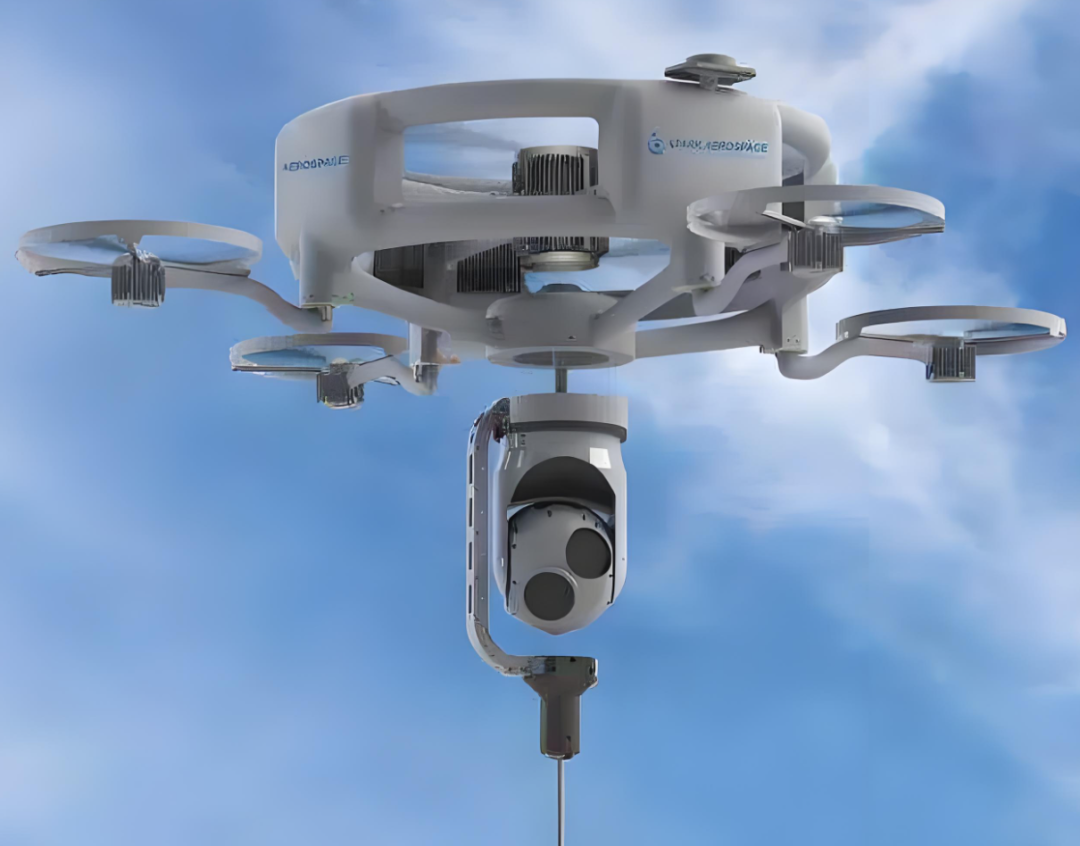
The typical configuration of a tethered drone’s photoelectric system consists of modules such as an optoelectronic pod (integrating cameras, infrared sensors, and a pan-tilt stabilization system), an image processing module (for real-time analysis and target tracking), and a data link (transmitting via tethered cables or wirelessly). Due to its special working modes (long-term hovering, continuous power supply, and adaptability to complex environments), the tethered drone imposes many critical requirements on the photoelectric system, such as high energy efficiency and low-power design, electromagnetic interference resistance and signal stability, environmental adaptability and vibration resistance, high-precision and multimodal fusion perception, lightweight and modular design, and real-time data processing and transmission.