
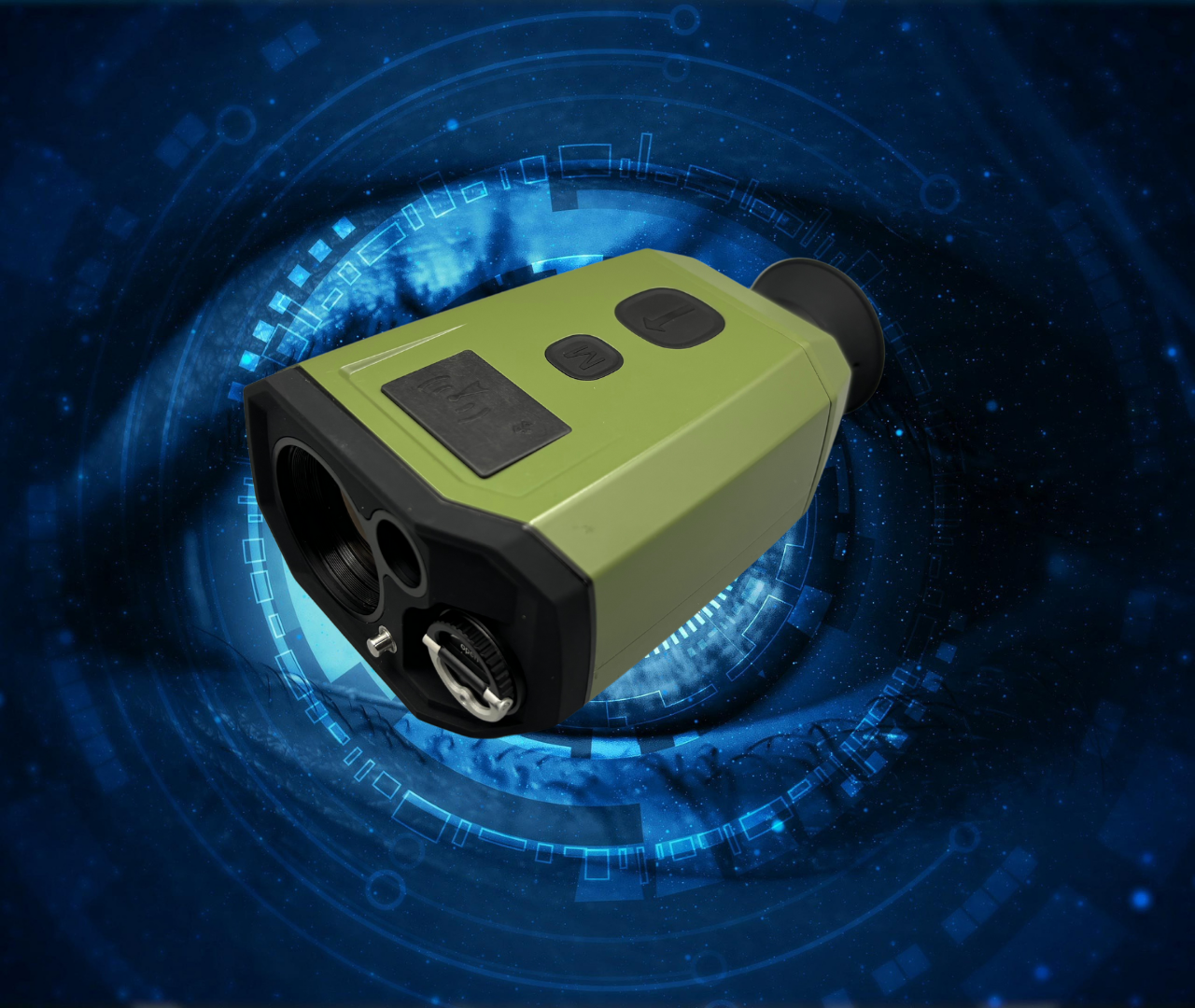
The principle of a pulsed laser rangefinder involves utilizing the characteristics of a laser beam to measure the distance between a target object and the rangefinder. Pulsed laser rangefinders typically consist of a laser, a transmitter module, a receiver, a clock, a counter, and a data processing unit.
The working principle of a pulsed laser rangefinder can be divided into two processes: transmission and reception.
In the transmission process, the laser beam generated by the laser is controlled by a recurrent control module and then emitted. The laser pulse has high instantaneous power and a short pulse width, usually as an infrared laser beam. The emitted laser beam passes through a lens or collimator to make it as parallel as possible, and it is then directed towards the measurement target.
During reception, after the laser beam is directed at the target, a portion of the laser light is scattered or reflected back to the rangefinder by the target object. This portion of the scattered laser light passes through the receiver module and is picked up by the receiver. The receiver converts the received laser signal into an electrical signal, which is then processed through amplification and filtering before being sent to the counter. The counter calculates the distance between the measurement target and the rangefinder based on the number and time interval of the received light pulses.
The received pulse signals contain signals from the target object as well as errors due to wavelength variations of the laser or other factors. To minimize these errors, pulsed laser rangefinders typically use techniques such as analog and digital filtering to process the received signal. These filtering techniques help to filter out noise and interference, thereby improving the accuracy of the rangefinder.
The clock system in a pulsed laser rangefinder accurately measures the time interval between light pulses. By measuring the time of flight of the pulses and the speed of light traveling through the air, the distance between the target object and the rangefinder can be calculated. Due to the extreme speed of laser light, pulsed laser rangefinders can perform measurements in nanoseconds.
The main advantages of pulsed laser rangefinders are their high measurement accuracy, large range, fast measurement speed, and non-destructive nature to the target object. Therefore, they are widely used in fields such as engineering measurement, construction measurement, aerospace measurement, geological exploration, robot navigation, and autonomous driving.