
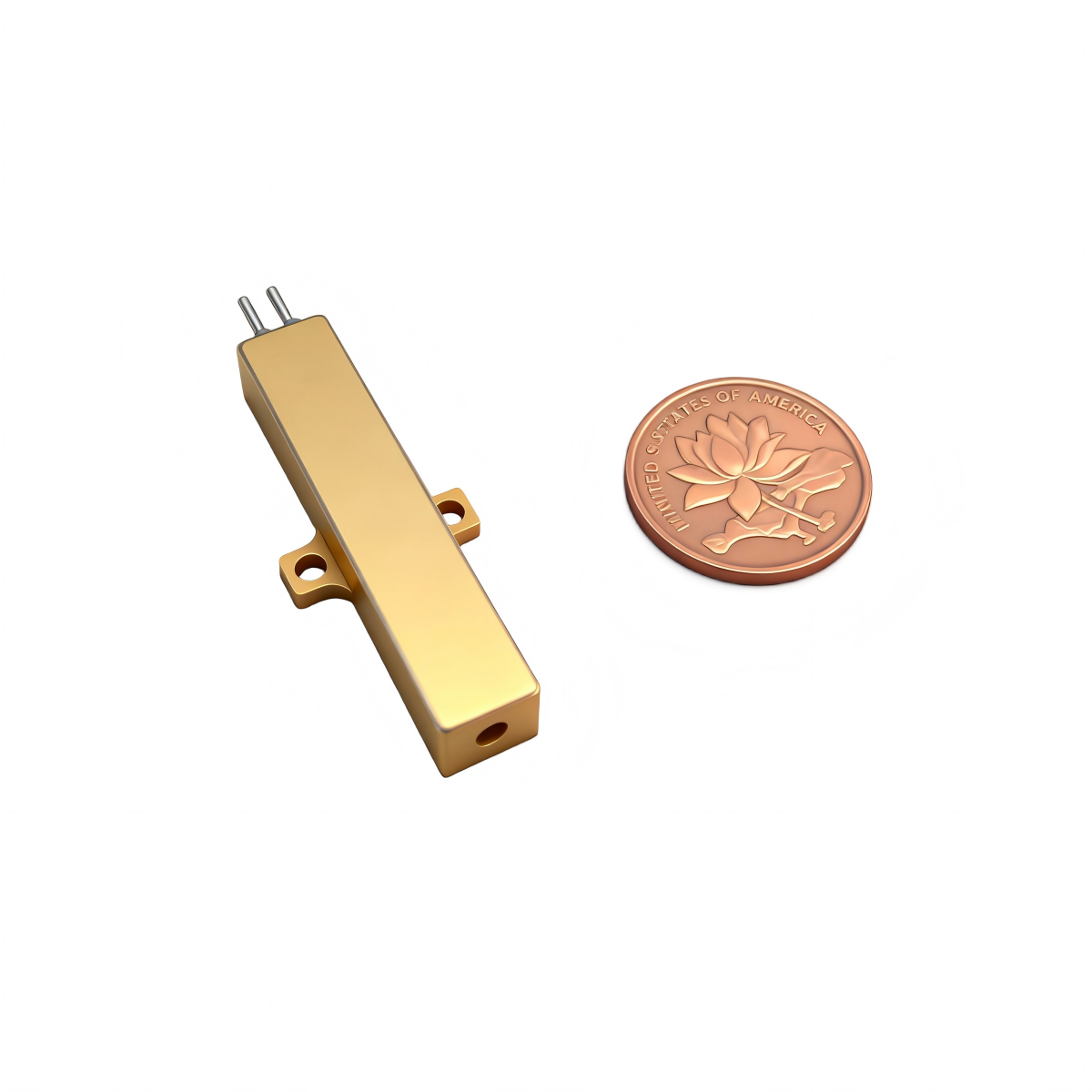
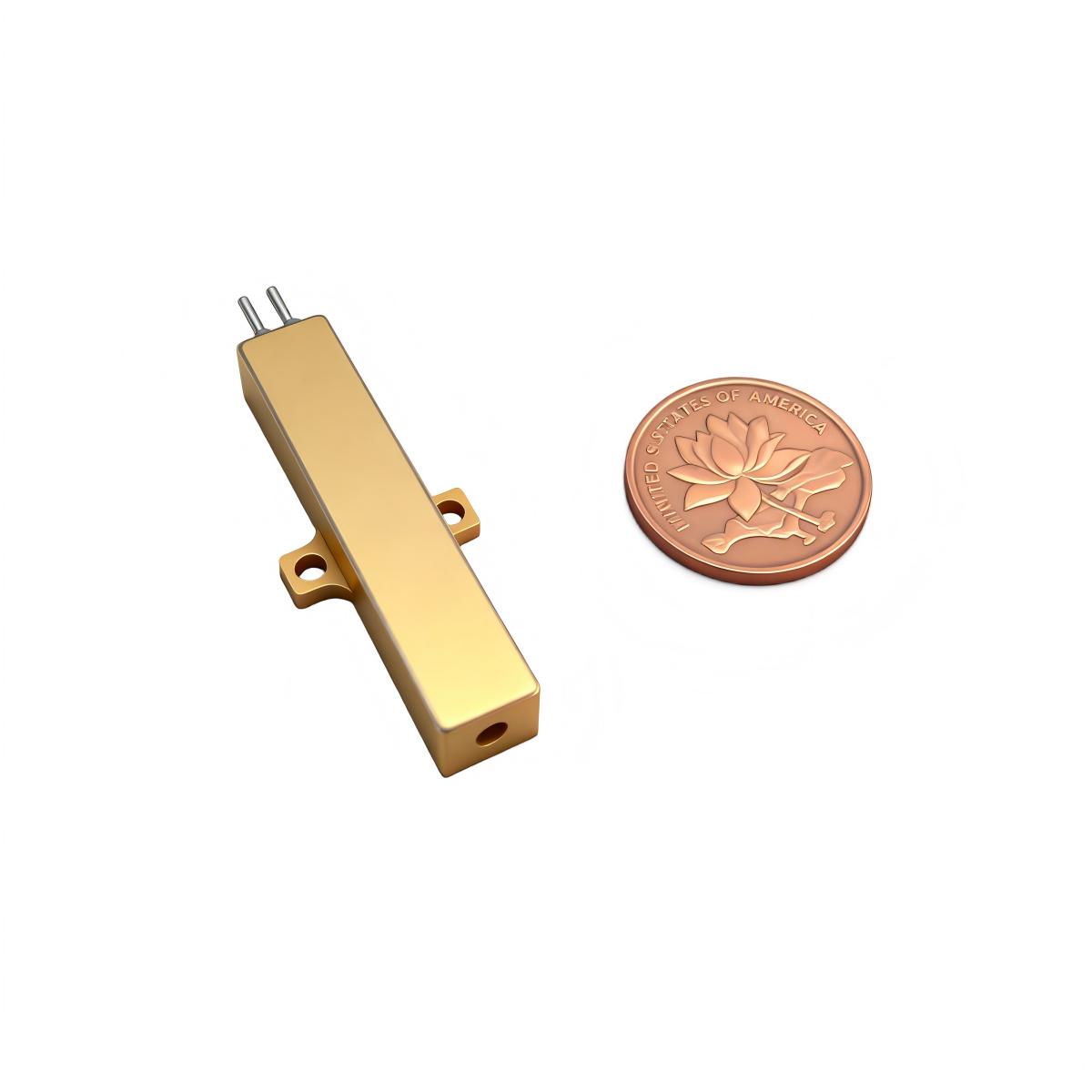
The ER800 is a compact pulsed transmitter designed for time-of-flight LiDAR and laser rangefinding. It uses an erbium-glass microchip laser architecture to produce short 1535 nm pulses in an 18 g package. This page explains the published module specifications and the electrical, optical and mechanical work required to integrate the device into an OEM sensor.
Why the ER800 is not an industrial fiber laser
Industrial fiber lasers are commonly optimized for continuous-wave or high-average-power material processing. The ER800 serves a different purpose. Its erbium-glass microchip architecture generates short, low-repetition-rate pulses for measuring distance from photon time of flight. The compact resonator and 1535 nm output make it relevant to rangefinder, LiDAR and electro-optical payload development rather than cutting or welding.
Published ER800 specifications
| Wavelength | 1535 nm |
|---|---|
| Pulse energy | ≥800 µJ |
| Pulse width | 7 ns |
| Repetition rate | 1–10 Hz |
| Pulse-energy stability | 10% |
| Raw beam | 0.3 mm diameter; ≤7 mrad divergence; TEM00 |
| Published drive interface | 2 V, 30 A pulse; drive pulse width ≤3 ms |
| Operating temperature | −40 °C to +65 °C |
| Dimensions and mass | 40 × 8 × 7.5 mm; 18 g |
These are module-level values published for the ER800 product. They are useful for early architecture work, but they do not replace acceptance testing in the customer's final optical and electrical configuration.
Electrical driver integration
The published 2 V, 30 A pulse requirement is a high-current transient, not a conventional low-current logic input. Driver design should minimize loop inductance, place pulse-energy storage close to the laser and control current amplitude and pulse width over temperature. The system designer should also verify trigger timing, electrical noise, protection behavior and recovery time at every intended repetition rate.
- Characterize the current waveform at the laser terminals rather than only at the driver output.
- Confirm that pulse width remains within the published ≤3 ms limit during start-up and fault conditions.
- Separate noisy pulse-current paths from detector, timing and communications circuits.
- Validate energy stability across supply tolerance, repetition rate and operating temperature.
Beam delivery and receiver alignment
The raw 0.3 mm beam and ≤7 mrad divergence require external optics for most long-range systems. A collimator or beam expander should be selected using the required aperture, field of view, spot size and packaging envelope. Optical coatings must be specified for 1535 nm, and the complete transmitter path should be checked for back-reflection, clipping and contamination sensitivity.
Range performance cannot be inferred from pulse energy alone. Target reflectivity, atmospheric loss, aperture size, receiver sensitivity, filtering, timing electronics and signal-processing thresholds all affect the usable distance. Prototype testing should therefore include representative targets and weather conditions.
Mechanical and thermal qualification
The 40 × 8 × 7.5 mm form factor supports compact LiDAR heads, handheld rangefinders and stabilized electro-optical payloads. The surrounding structure still needs a repeatable datum, controlled clamping force and a thermal path that does not distort the resonator or alignment. Qualification should cover temperature cycling, vibration, shock, humidity and long-duration pulse operation at the assembled-system level.
Eye safety is a system-level responsibility
The ER800 product specification identifies a module-level Class 1 laser classification. Once the module is combined with drive electronics and beam-expanding optics, the final product must be assessed again for its intended access conditions, pulse sequence and aperture. Integrators should complete the applicable laser-safety analysis, labeling and compliance testing before release.
Choosing the ER800 for an OEM program
The ER800 is a candidate for teams that need a compact 1535 nm pulsed source with ≥800 µJ output and low-frequency operation. Before design-in, confirm the required pulse-energy distribution, beam specification, environmental profile, production test method and interface documentation with ERDI. Review the full ER800 product page or contact ERDI with your optical layout and operating requirements.