
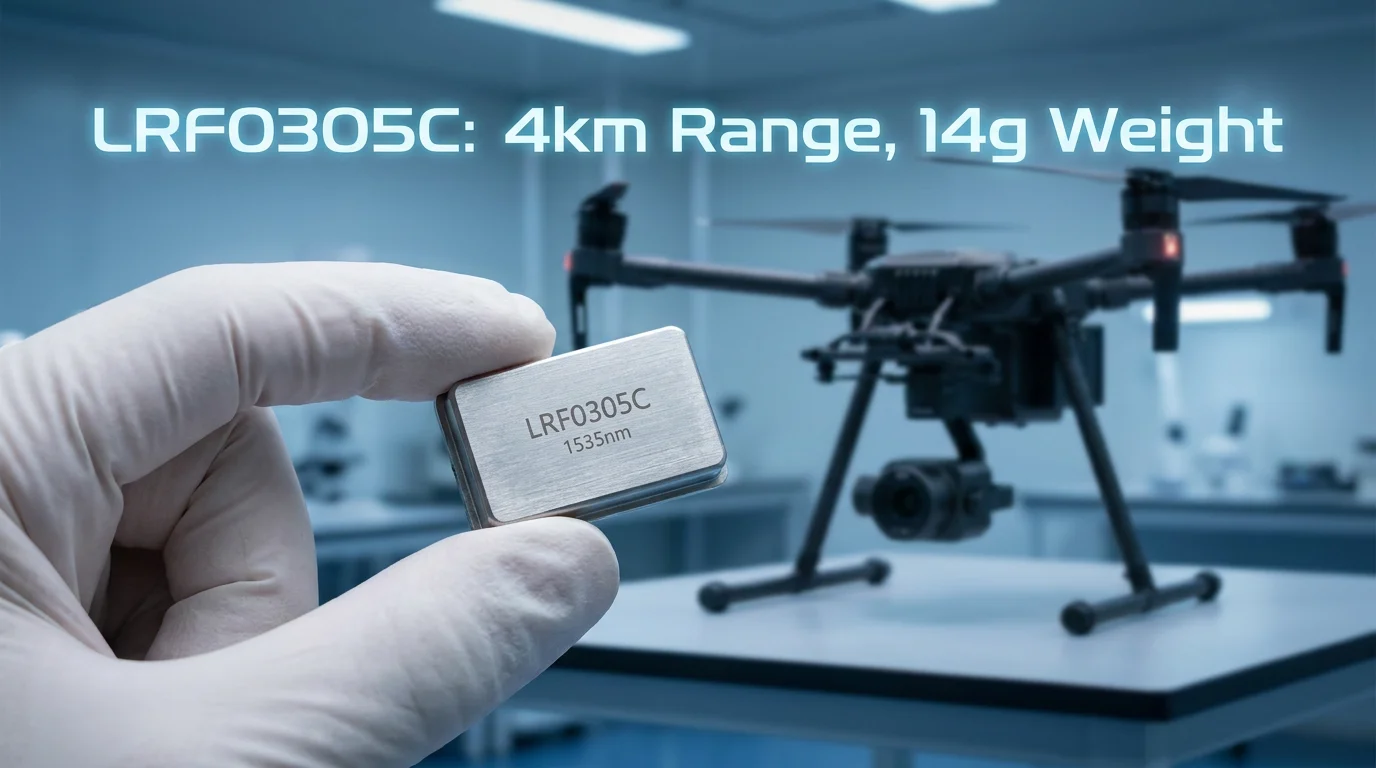
A Technical Guide to Integrating 1535nm Eye-Safe Laser Rangefinders in UAV Gimbal Payloads
Author: ERDI Tech Engineering Team
Target Audience: Gimbal System Integrators, UAV Payload Engineers, Optronics Hardware Designers
Keywords: #LaserRangefinder #1535nm #UAVIntegration #GimbalPayload #SWaP #ErbiumGlassLaser #Sensors
Abstract
Integrating long-range optical sensors into Unmanned Aerial Vehicle (UAV) micro-gimbals and Electro-Optical/Infrared (EO/IR) pods presents severe engineering trade-offs between Size, Weight, Power, and Cost (SWaP-C). Traditional 905nm diode-based rangefinders suffer from high beam divergence and poor atmospheric penetration, while 1064nm solid-state lasers present non-eye-safe radiation profiles.
This guide analyzes the technical advantages of 1535nm Erbium-doped glass (Er:glass) laser rangefinder (LRF) modules—specifically the ERDI LRF0305C and LRF1525C—and provides concrete engineering guidelines for optical alignment, electrical interfaces, and mechanical integration.
1. Technological Comparison: Why 1535nm for Airborne Systems?
When designing a stabilized optical gimbal, selecting the optimal laser wavelength directly impacts mission capability and eye safety. The three primary wavelengths utilized in airborne optronics are compared below:
| Feature | 905 nm (Diode) | 1064 nm (Solid-State / Nd:YAG) | 1535 nm (Erbium-doped Glass) |
|---|---|---|---|
| Eye-Safety Class | Class 1M / 3R (Hazardous at range) | Class 3B / 4 (Extremely Hazardous) | Class 1 (Absolute Eye-Safe) |
| Typical Range | 100 m – 1,500 m | 300 m – 20,000 m | 50 m – 15,000 m+ |
| Beam Divergence | High (1.5 × 3.0 mrad typical) | Medium (≤ 0.6 mrad) | Extremely Low (≤ 0.4 mrad to 0.6 mrad) |
| Haze/Smoke Penetration | Poor | Medium | Excellent (Superior eye-safe atmospheric transmission) |
| Detector Materials | Silicon (Si) APD | InGaAs APD / Silicon | InGaAs APD |
| NVD Stealth | High Visibility (905nm is visible) | Invisible (Requires special seekers) | Absolute Stealth (Invisible to standard NVDs) |
For system integrators, 1535nm Er:glass lasers represent the sweet spot: they provide multi-kilometer ranging capabilities with surgical spot size and complete eye safety, making them ideal for both civilian mapping and tactical law enforcement operations.
2. Technical Profile of Target Integration Modules
ERDI Tech manufactures specialized LRF modules that address different drone weight categories:
A. The Micro-Gimbal Specialist: ERDI LRF0305C
- Mass: $le 14 ext{ g}$
- Dimensions: $27 ext{ mm} imes 25 ext{ mm} imes 15.5 ext{ mm}$
- Ranging Distance: $10 ext{ m}$ to $4,000 ext{ m}$ (against high-reflectivity targets)
- Best For: Sub-2kg Class I drones, micro-gimbals, and handheld thermal scopes.
B. The Long-Range Reconnaissance Unit: ERDI LRF1525C
- Mass: $le 400 ext{ g}$
- Dimensions: $125 ext{ mm} imes 85 ext{ mm} imes 58.5 ext{ mm}$
- Ranging Distance: $50 ext{ m}$ to $ge 15,000 ext{ m}$
- Best For: Tactical UAV platforms, military-grade stabilized EO/IR turrets.
3. Mechanical Integration and Thermal Management
Airborne platforms subject optical sensors to high-frequency structural vibrations, aerodynamic shock loads, and extreme thermal environments. Successful mechanical integration must adhere to the following principles:
3.1. Optical Axis Alignment and Bore-Sighting
The LRF module must be strictly co-axial (bore-sighted) with the gimbal's visible zoom camera and thermal imaging (MWIR/LWIR) sensor. 1. 3-Point Mounting Interface: Use the module's precision locating holes rather than relying on clamp-style mounts, which can warp the internal optical cavity. 2. Structural Rigidity: The mounting bracket must be CNC-machined from aircraft-grade aluminum (Al 7075-T6) to prevent mechanical deflection during gimbal acceleration.
3.2. Vibration Isolation
Airborne rotor vibrations (typically $50 ext{ Hz} ext{--} 200 ext{ Hz}$) can introduce jitter in the laser beam, spreading the spot size. * Damper Selection: Mount the entire EO/IR payload on wire-rope isolators or silicone dampers calibrated to the platform's wet-weight. * Internal Buffering: The LRF0305C features an internally ruggedized optical bench certified to withstand shocks up to $1200 ext{ g } ( ext{at } 1 ext{ ms})$, but external high-frequency dampening is highly recommended to protect the receiver electronics.
3.3. Thermal Dissipation
Erbium-doped glass lasers generate thermal energy during high-frequency firing (e.g., operating at $10 ext{ Hz}$). * Conductive Cooling: Ensure the mounting surface of the LRF module makes direct metal-to-metal contact with the gimbal's aluminum chassis. Use high-conductivity thermal pads ($ge 3.0 ext{ W/m}cdot ext{K}$). * Monitoring: Read the internal temperature sensor values via the UART interface to implement automatic thermal throttling if the module exceeds $+65^circ ext{C}$.
4. Electrical and Communication Interface
4.1. Pin Interface (UART TTL 3.3V)
For micro-modules like the LRF0305C, communication is facilitated via a standard 1.25mm pitch connector. The typical pin definition is structured as follows:
| Pin Number | Name | Type | Description |
|---|---|---|---|
| 1 | VCC | Power | DC Power Input (Typically $3.3 ext{V} ext{--} 5.0 ext{V}$) |
| 2 | GND | Ground | Common system ground reference |
| 3 | TXD | Output | Transmit Data (UART TTL 3.3V) to Flight Controller/MCU |
| 4 | RXD | Input | Receive Data (UART TTL 3.3V) from Flight Controller/MCU |
| 5 | TRIG | Input | Hardware trigger line (Low-pulse triggered) |
4.2. Power Supply Stability
The pulsed laser requires rapid capacitor charging, which draws high transient current spikes. * Decoupling Capacitors: Install a $220mu ext{F}$ low-ESR tantalum capacitor in parallel with the power input line near the LRF pin connector to prevent voltage dips that could reset the gimbal's main MCU.
5. Software Communication Protocol (Sample Framework)
The host computer commands the LRF module using short, hex-encoded command packets. Below is a typical packet format for triggering a single range measurement:
Trigger Ranging Command (Host to LRF)
0xEB 0x90 0x01 0x02 0x00 0x03 0x06
- Header:
0xEB 0x90(Standard synchronization word) - Address:
0x01(Default module ID) - Command:
0x02(Measure distance) - Length:
0x00 0x03(Number of parameter bytes) - Checksum:
0x06(Sum of fields modulo 256)
Ranging Output Packet (LRF to Host)
Upon successful ranging, the module returns a packet containing the target distance in decimeters (or millimeters) and the echo signal strength.
6. Frequently Asked Questions (FAQ) for Gimbal Designers
Q1: Can 1535nm lasers penetrate heavy clouds or heavy rain?
A: 1535nm lasers offer significantly higher atmospheric transmission through fog and haze compared to 905nm systems because 1535nm light experiences less Rayleigh scattering. However, severe physical blockages like heavy cloud cover or dense torrential rainfall will attenuate any optical signal.
Q2: Does the ERDI LRF0305C support multi-target tracking?
A: Yes. The LRF0305C has built-in signal processing firmware that supports multi-echo detection. It can detect and report the distances of up to 3 separate targets within its field of view, which is extremely useful for filtering out tree branches or camouflage netting.
Q3: How do I choose between the LRF0305C and LRF1525C?
A: If your platform is a rotary-wing drone (quadcopter) under $5 ext{kg}$ where payload capacity is restricted to a few hundred grams, choose the LRF0305C ($14 ext{g}$). If you are integrating a high-altitude fixed-wing UAV or boundary-patrol optronics mast requiring a measuring range beyond $10 ext{km}$, the LRF1525C ($400 ext{g}$) is the standard choice.
Conclusion
Integrating a 1535nm eye-safe laser rangefinder module is the most effective way to elevate a drone payload's target-acquisition capabilities. By following these strict bore-sighting, electrical decoupling, and conductive-cooling standards, system integrators can achieve highly reliable, surgical-grade ranging performance in the most challenging flight environments.
For direct technical inquiries, detailed interface control documents (ICDs), or pricing on evaluation units, please reach out directly:
Yilin Wen
ERDI TECH LTD | Technical Sales & Support
📧 Email: sales@erdicn.com
🌐 Website: https://erdicn.com
Product Catalog: ERDI Laser Rangefinder Modules