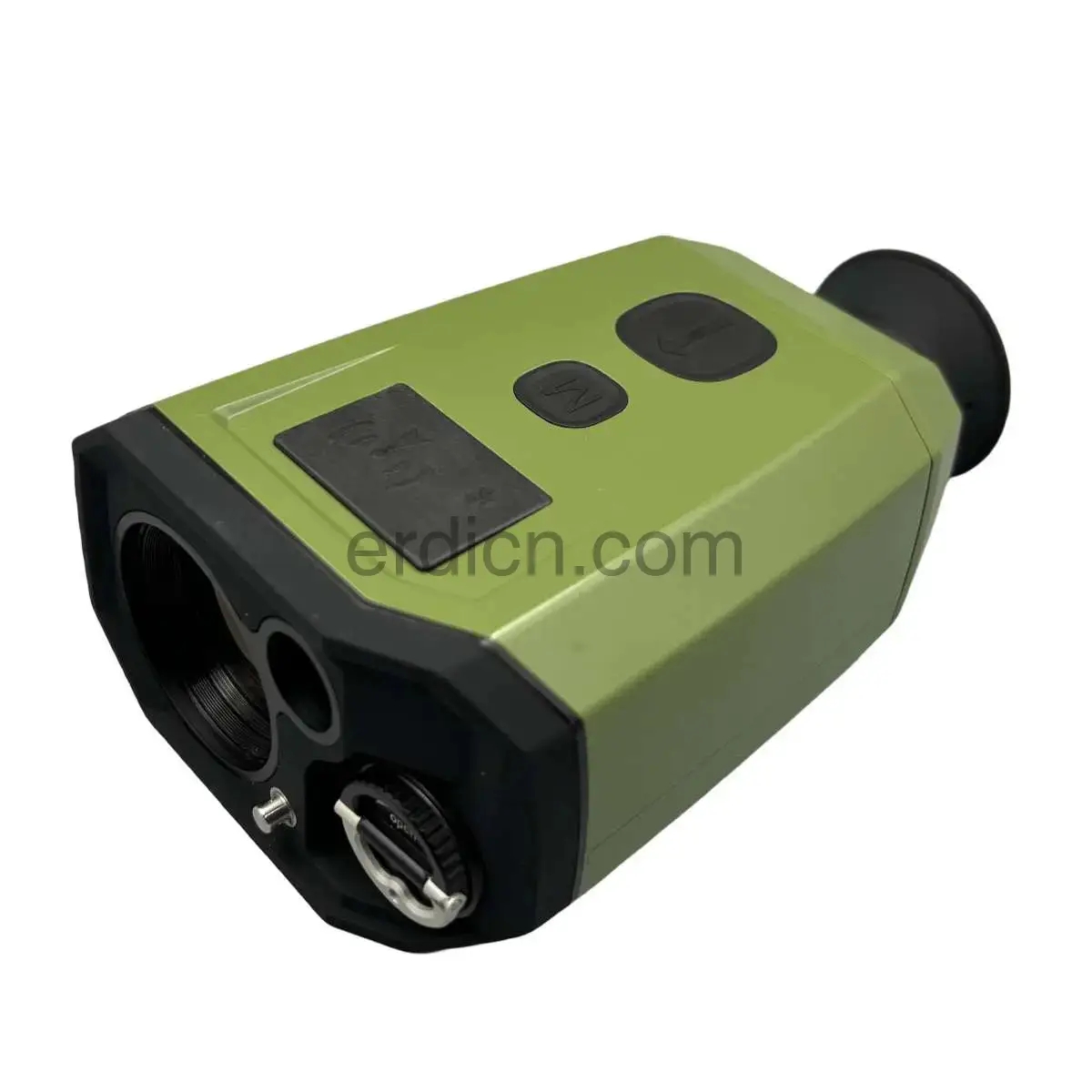
Ahandheld laser rangefinder is an instrument that accurately measures the distance to a target using laser technology. When the laser rangefinder is in operation, it emits a very thin laser beam towards the target. Then, an optoelectronic component receives the laser beam reflected by the target. A timer measures the time it takes for the laser beam to travel from emission to reception, thereby calculating the distance from the measurer to the target.
Laser ranging has characteristics such as high measurement accuracy, long measurement range, good directivity, strong anti – interference ability, good concealment, and simple and rapid operation. In the early days, it was mainly applied in the military field, such as topographic surveying, target ranging, determination of the altitude of aircraft and missiles, etc. Besides being used for direct observation by troops, it is also combined with other equipment to form multi – functional devices, which are widely used in various optoelectronic systems or weapon guidance.
Common application fields of laser ranging include but are not limited to the following scenarios:
1. In the field of construction and engineering
Architectural Surveying: In the field of architectural surveying, handheld laser rangefinders play an indispensable role. For new construction projects, architects can use it to quickly measure the height of buildings. The vertical distance from the ground to the roof can be easily obtained. When measuring the width, there is no need for complex tape – measuring operations, and accurate data will appear instantly. This provides a reliable basis for design planning, helps accurately assess the project scale, and further reasonably estimate the construction cost. In the interior decoration stage, designers use it to measure the dimensions of each side of the indoor space. Based on the measurement results, they can scientifically plan the furniture layout, making the space utilization more reasonable and improving the comfort of living and working.
Engineering Monitoring: In the construction process of large – scale projects such as bridges, tunnels, and subways, laser rangefinders are crucial equipment to ensure the smooth progress of construction. When building a bridge, it can accurately measure the dimensions of various bridge components, such as the length of steel beams and the distance between bridge piers. This enables construction workers to build in strict accordance with the design requirements, effectively guaranteeing construction accuracy and quality. During tunnel excavation, it can measure the deviation between the tunnel contour and the design line in real – time, and adjust the excavation direction in a timely manner. Moreover, during the operation phase of the project, the laser rangefinder can continuously monitor the deformation and displacement of the project. Once abnormal data is detected, it can issue an early warning in a timely manner, enabling relevant personnel to quickly take measures such as reinforcement and repair, nipping potential safety hazards in the bud and ensuring the long – term stable operation of the project.
2. Geographical Surveying and Mapping