
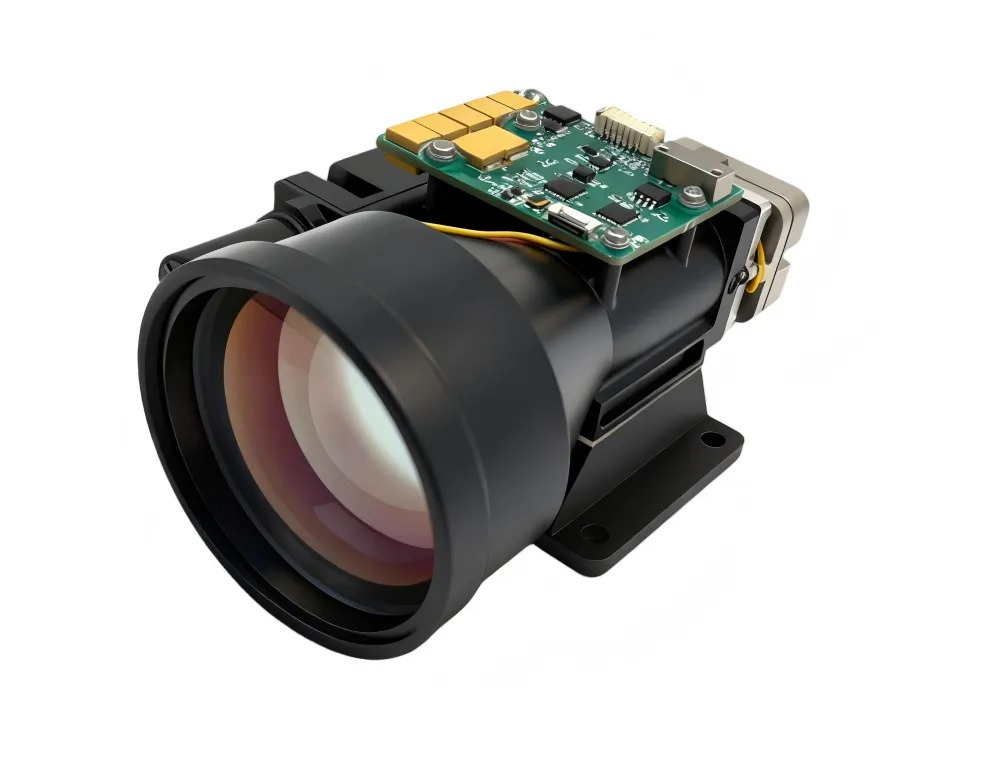
Infrared laser rangefinders measure distance with light that is outside the visible spectrum. A transmitter sends a short optical pulse toward a target, while a receiver records the reflected signal. The measured round-trip time is converted into distance. Reliable performance depends on the complete optical, electrical, mechanical and software design, not on wavelength alone.
How pulse time-of-flight ranging works
A pulsed rangefinder starts a timing circuit when the laser pulse is emitted and stops it when a valid return is detected. Because the pulse travels to the target and back, the measured travel time is divided by two when distance is calculated. The receiver must distinguish the target return from sunlight, detector noise, atmospheric backscatter and reflections from foreground objects.
Range-gate settings, threshold logic, pulse averaging and first- or last-target selection affect the reported result. Integrators should define these behaviors before selecting a module because two devices with the same nominal maximum range can respond differently in a real scene.
Choosing an operating wavelength
| Wavelength | Typical engineering considerations |
|---|---|
| 905 nm | Often paired with silicon detectors and compact electronics. Availability and cost can be attractive, but permitted exposure and finished-system laser classification still require a formal assessment. |
| 1064 nm | Common in pulsed solid-state laser systems and target-designation applications. Detector choice, optical coatings and receiver filtering must match the wavelength. Invisible 1064 nm radiation is not inherently eye-safe. |
| 1535 nm | Frequently selected for long-range and eye-safety-oriented system designs. Performance depends on the source, detector, receiver aperture and optical losses. The completed product, operating mode and accessible emission determine its safety classification. |
What determines usable range
- Target properties: size, reflectivity, angle and surface finish influence return energy.
- Transmitter: pulse energy, pulse width, repetition rate and beam divergence determine how much energy reaches the target.
- Receiver: aperture, detector sensitivity, bandwidth, filtering and signal processing determine whether the return can be detected.
- Atmosphere: visibility, rain, fog, dust, turbulence and solar background can reduce signal-to-noise ratio.
- Platform: pointing error, vibration, boresight alignment and window contamination can reduce practical range.
Published range values should therefore be read together with the stated target, visibility and detection-probability conditions. A vehicle target in clear air is not equivalent to a small, dark or oblique target in poor visibility.
OEM integration checklist
- Mechanical: confirm envelope, mounting datums, clear aperture, boresight adjustment and alignment retention.
- Electrical: verify supply range, peak current, grounding, startup behavior and protection against transients.
- Data interface: document command timing, output format, range units, status flags, checksums and fault responses.
- Thermal: provide a defined heat path and test performance across the intended temperature range and duty cycle.
- Optical: check window transmission, coatings, stray-light control and compatibility with other sensors in the payload.
Validation and laser safety
Prototype testing should cover accuracy, repeatability, false returns, multiple targets, minimum and maximum range, temperature, vibration, electromagnetic compatibility and boresight retention. Test conditions and pass criteria should be recorded so that supplier data and platform results can be compared directly.
Infrared radiation is invisible and can present a laser hazard. The finished equipment requires the appropriate enclosure, interlocks, labels, operating procedures and laser-safety evaluation. A module wavelength or supplier specification does not by itself establish compliance or safe use.
Planning an ERDI integration
Provide the target type, required range, wavelength, repetition rate, accuracy, size and weight limits, electrical interface, operating environment and qualification requirements when requesting a module recommendation. Contact ERDI TECH LTD for current datasheets, interface documents and OEM integration support.