
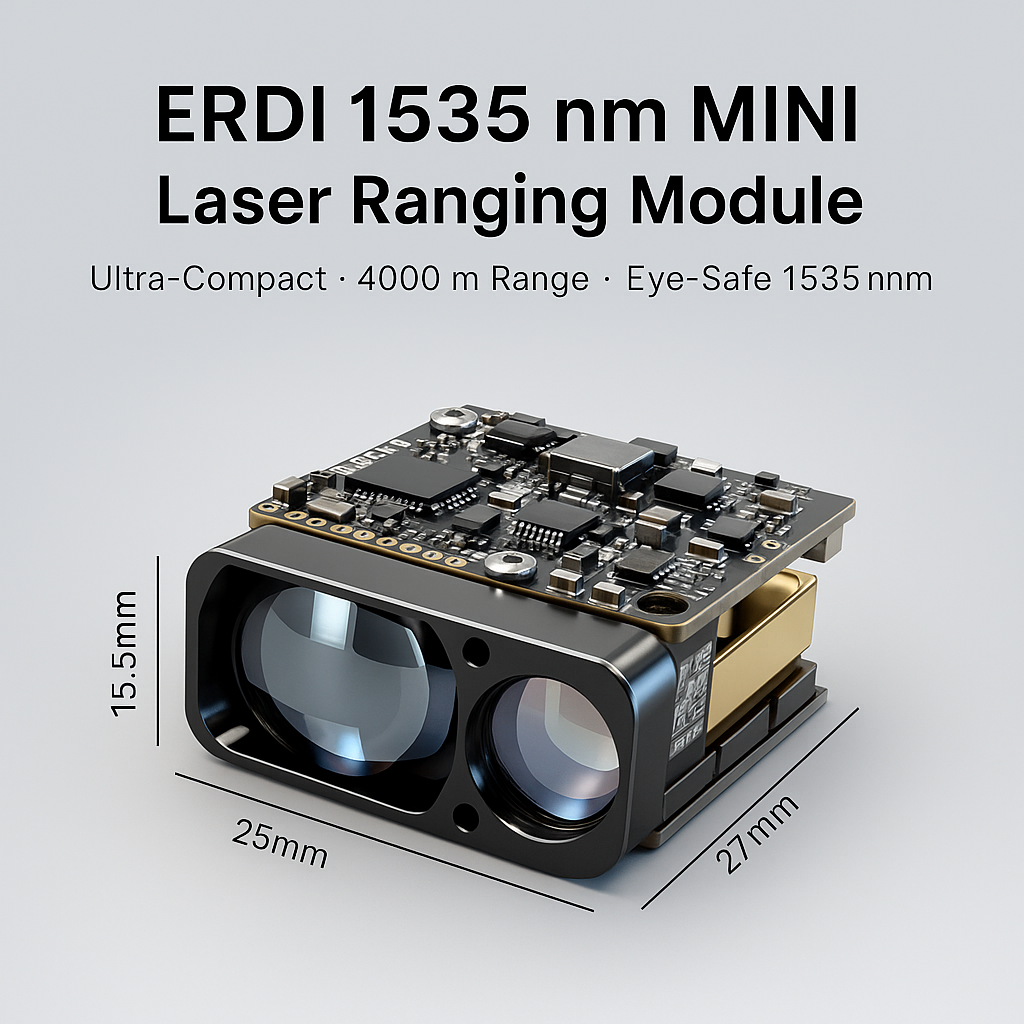
As laser ranging technology advances at high speed, device miniaturization has become an irreversible industry trend. UAV payloads, handheld rangefinders, EO/IR gimbals and smart terminals are all pushing for lighter, thinner and lower-power components. Traditional ranging assemblies struggle with bulky size, heavy weight and limited energy efficiency.
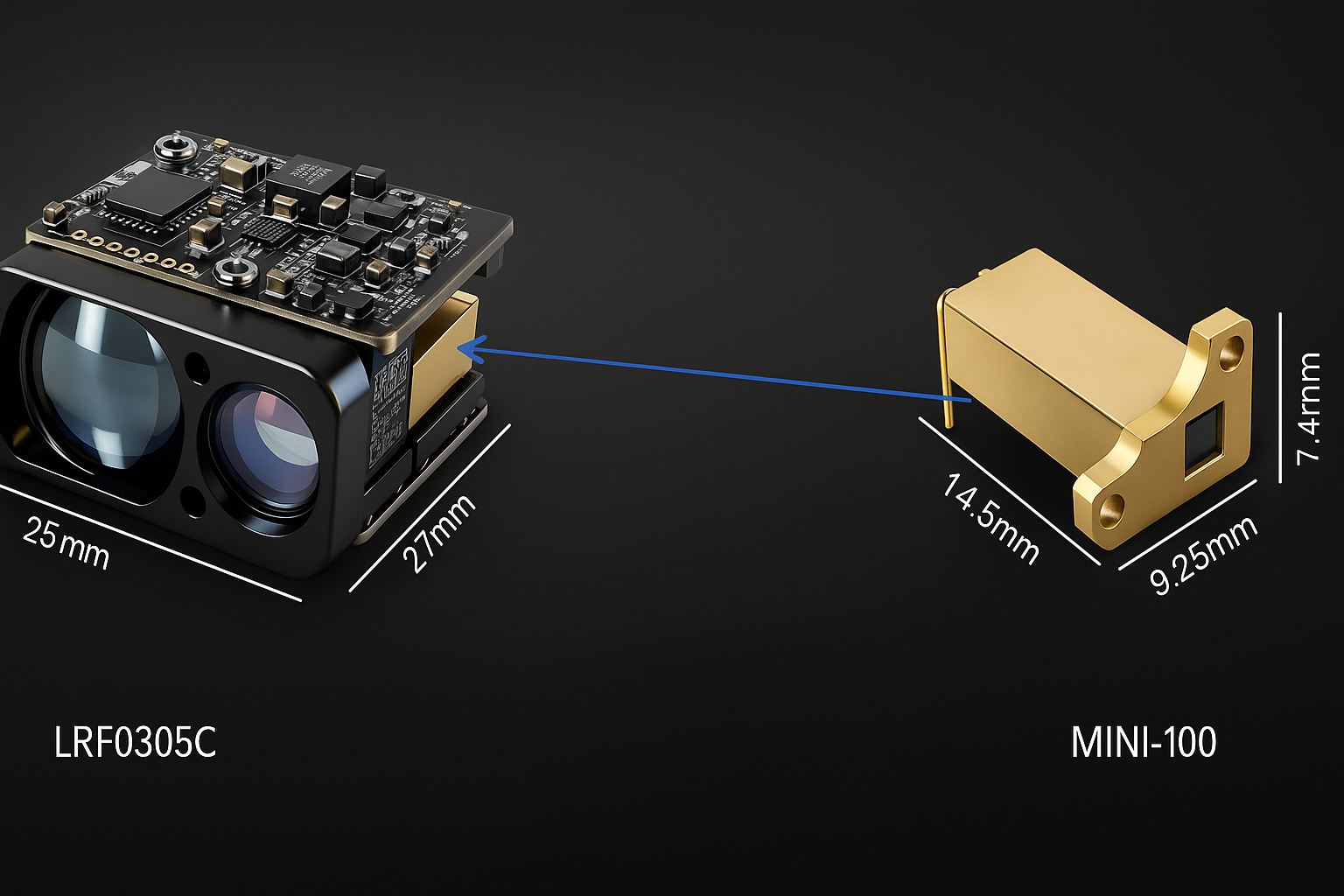
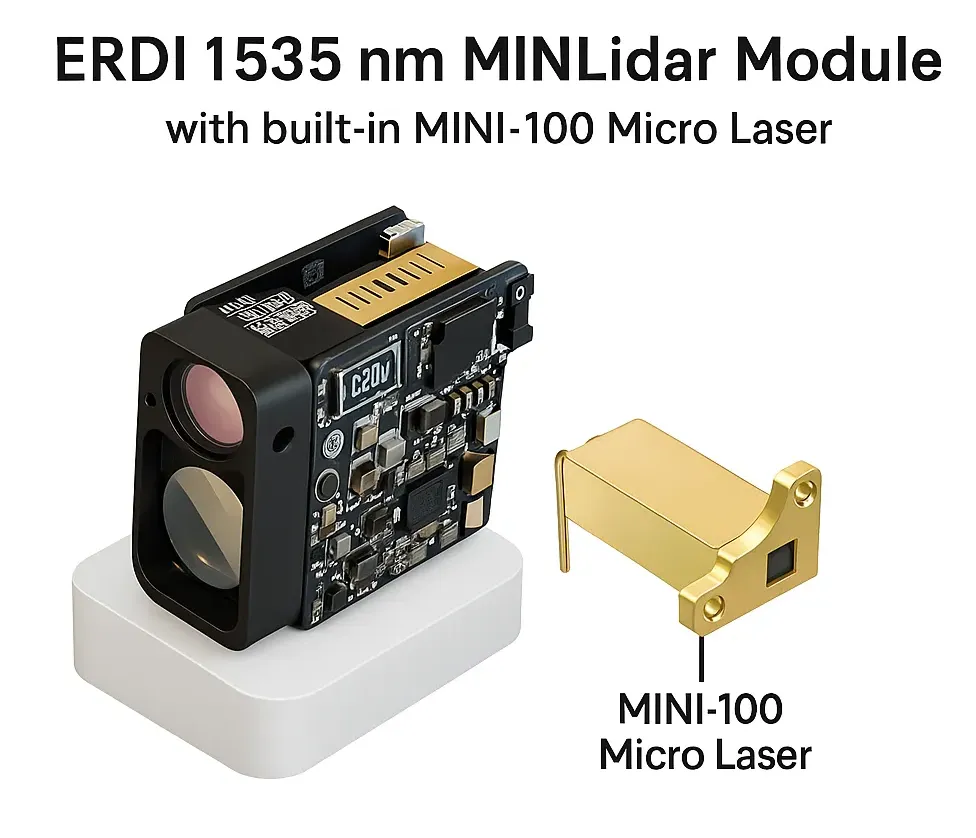
Responding to the demand for “smaller, stronger and safer” ranging cores, ERDI has launched its 1535 nm MINI eye-safe laser ranging module, together with the self-developed MINI-100 1.54 μm erbium glass pulsed solid-state laser. This combination is not only a breakthrough in physical size, but also a major leap for high-energy miniature ranging components.
01 Miniaturization vs. High Energy – A Growing Industry Contradiction
Across rangefinders, UAV payloads and compact electro-optical devices, the market is undergoing a profound shift toward miniaturization:
-
UAV platforms need lighter, lower-power ranging cores to extend flight time and increase mission efficiency.
-
Soldier systems demand more portable rangefinders without compromising performance.
-
Smart equipment manufacturers want highly modular, easy-to-integrate ranging blocks, but conventional modules occupy large space, require high drive currents and complex thermal design.
-
Industrial and civilian buyers place increasing weight on eye-safety ratings, making laser safety class a key procurement parameter.
The common contradiction is clear:
Smaller size → lower energy density → weaker ranging capability.
In particular, 1.5 μm lasers at the 100 μJ level traditionally require:
-
Tens of millimeters of cavity length
-
Large resonator mirror structures
-
Complex LD pumping and heat dissipation designs
As a result, achieving “miniature size + long-range measurement” has long been seen as nearly impossible.
ERDI’s new solution breaks this deadlock by combining ultra-small size, high pulse energy and Class 1 eye-safety in a single platform.
02 ERDI 1535 nm MINI Laser Ranging Module: Redefining “Miniature Ranging”
The launch centers on two key products that work seamlessly together.
2.1 1535 nm MINI Laser Ranging Module (LRF Solution)
-
Ranging capability: 0–4000 m (target reflectivity 0.3, 20 °C)
-
Accuracy: ±1 m
-
Beam divergence: ≤ 0.6 mrad
-
Multi-target measurement: Supported
-
Field of view (FOV): 7.4 mrad
-
Communication interface: UART TTL
-
Operating temperature: –20 to +60 °C
-
Integration level: Laser, driver, receiver and ranging algorithm integrated in one compact module
2.2 Self-Developed MINI-100 Er:Yb Glass Pulsed Laser
-
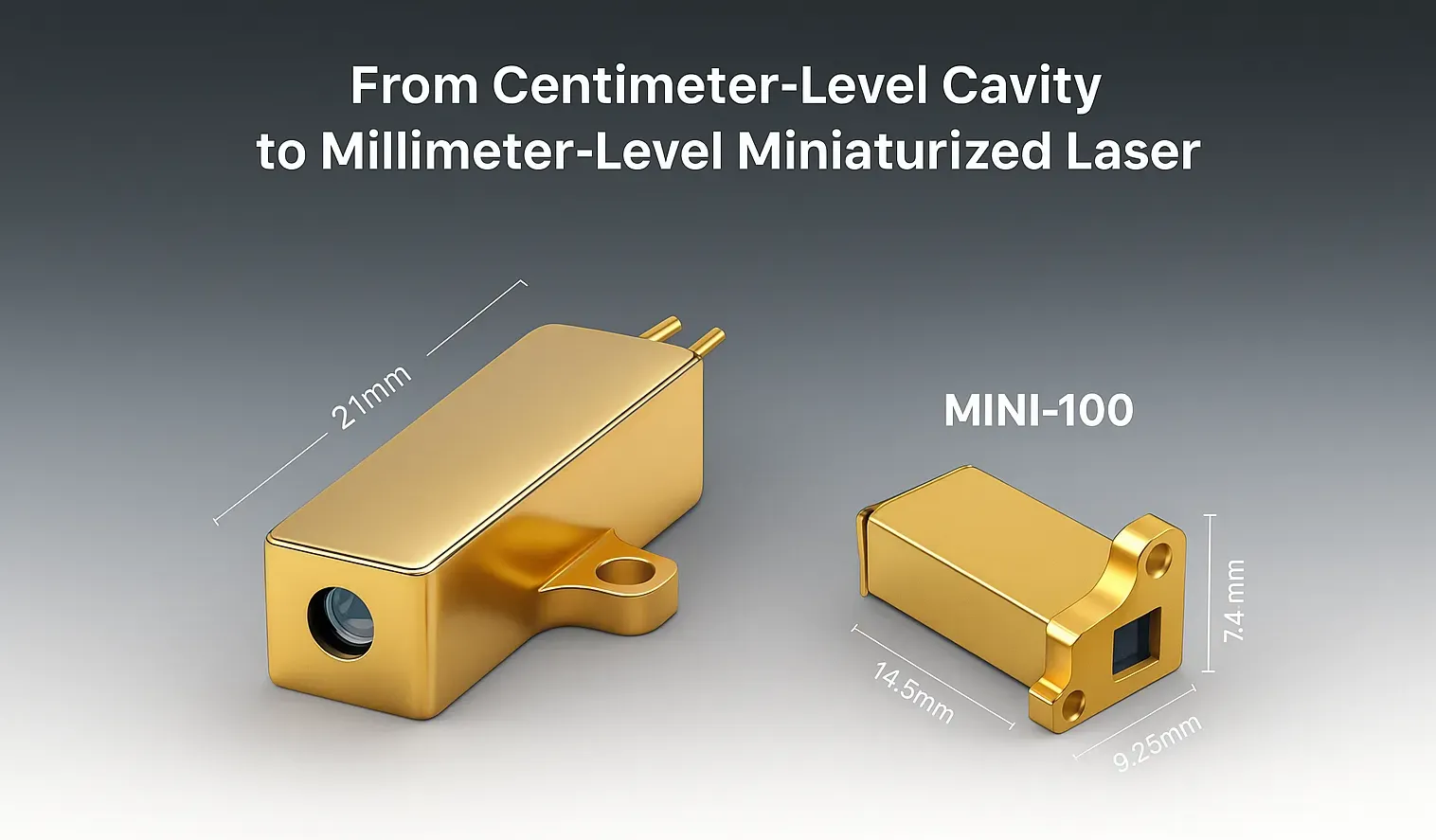
Dimensions: 14.5 × 6.3 × 4.37 mm³
-
Weight: 2.5 g
-
Pulse energy: ≥ 100 μJ
-
Pulse width: 3.5 ns
-
Repetition rate: 1–10 Hz
-
Wavelength: 1535 nm (eye-safe Class 1 band)
-
Shock & vibration: Compliant with MIL-STD-810G
-
Operating temperature: –40 to +65 °C
Together, they form a low-weight, low-power, high-power-density, algorithm-ready miniature ranging core, giving the industry a new “mini-class ranging brain”.
03 Industry-Leading Size Breakthrough: 14.5 × 6.3 × 4.37 mm³ at 100 μJ
The standout feature of MINI-100 is its extreme compactness. In the past, 1535 nm lasers with 100 μJ pulse energy typically required:
-
Long cavities on the order of several centimeters
-
Larger mechanical support for resonator mirrors
-
More complex LD pump assemblies and thermal paths
By optimizing the cavity design, passive Q-switching, energy coupling efficiency and micro-machining of Er:Yb glass, ERDI engineers have implemented six key process breakthroughs. The result: a laser that maintains ≥ 100 μJ pulse energy while fitting into a 14.5 × 6.3 × 4.37 mm³ volume.
This size is approaching what many in the industry considered “non-compressible” for this energy class, making MINI-100 an ideal light source for:
-
Micro rangefinders
-
Soldier-borne terminals
-
UAV EO/IR payloads
-
Modular sensing devices
04 1535 nm Class 1 Eye-Safe: The Core Value for Open-Air Ranging
Compared with 905 nm lasers, 1535 nm offers a set of inherent advantages:
| Parameter | 905 nm | 1535 nm |
|---|---|---|
| Eye-safety class | Strict power limitation required | Up to Class 1M / Class 1 |
| Maximum permissible exposure (MPE) | Low | Dozens of times higher |
| Atmospheric transmission | Medium | Excellent |
| Performance in rain/fog | Medium to low | High |
| Long-range capability | Medium | Stronger |
In other words,
1535 nm is the more suitable wavelength for outdoor and unmanned platforms.
The ERDI MINI-100 laser is based on Er:Yb co-doped phosphate glass, concentrating energy while preventing retinal damage. This makes it ideal for:
-
Low-altitude UAV operations
-
Automotive and vehicle obstacle detection
-
Outdoor industrial work
-
Open environments where people may be present without protective eyewear
This directly enhances the feasibility of deploying high-performance ranging in the civilian market.
05 3.5 ns Pulse Width & High Peak Power: Centimeter-Level Accuracy Made Easy
Thanks to passive Q-switching, MINI-100 delivers a pulse width of only:
3.5 ns
Short pulses bring multiple benefits:
-
Higher time-of-flight (ToF) resolution
-
More sensitive echo detection
-
Stronger resistance to background light interference
-
Centimeter-level ranging resolution in properly designed systems
In the ERDI MINI ranging module, this translates into ±1 m accuracy while still maintaining a 4000 m maximum range.
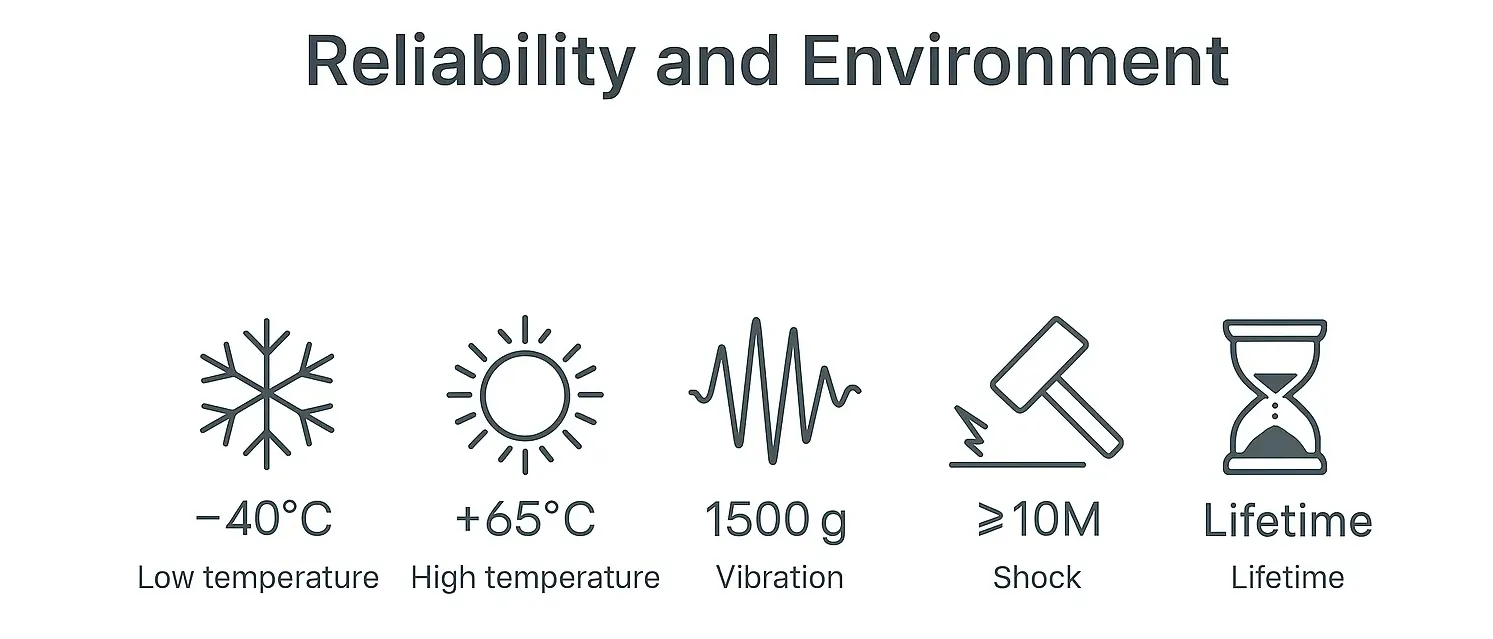
06 MIL-STD-810G Reliability: Designed for Harsh Environments
The ERDI MINI laser is engineered to meet demanding field conditions:
-
Shock: 1500 g (0.5 ms)
-
Vibration: 20–2000 Hz / 20 g
-
Operating temperature: –40 to +65 °C
-
High-humidity tolerance
-
Strong background light suppression
-
Service life: ≥ 10 million shots
This robustness enables stable deployment on:
-
High-vibration UAV platforms
-
Vehicle-mounted EO systems
-
Shipborne stabilized gimbals
-
Outdoor survey equipment in extreme cold
-
High-temperature desert environments
From the lab to real-world missions, the MINI series covers the full spectrum of application scenarios.
07 System Integration Value: Low Power, UART TTL and Modular Design
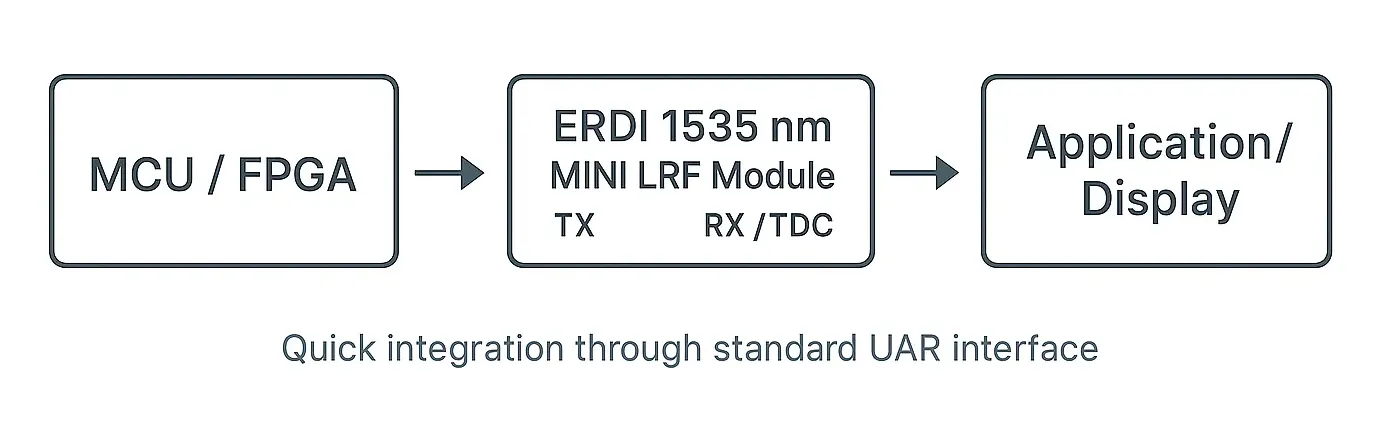
From a system-engineering perspective, the ERDI MINI ranging module provides several integration benefits:
-
Standard UART TTL interface, easy connection to MCUs, FPGAs or host processors
-
Modular package, adaptable to different mechanical designs
-
Low-power architecture, ideal for battery-powered devices
-
Built-in multi-target detection algorithms
-
Stable 7.4 mrad FOV, improving target acquisition probability
For integrators, this greatly simplifies:
-
Optical path design
-
Laser driver implementation
-
Echo signal acquisition
-
ToF algorithm development
-
System calibration and validation
All of this results in significantly shorter development cycles for end products.
08 Typical Applications: A New “Standard Core” from UAVs to Rangefinders
The ERDI MINI ranging module is designed as a universal core for a wide variety of platforms.
8.1 UAV Mapping, Inspection and Low-Altitude Reconnaissance
Its ultra-low weight and compact size make it easy to embed into:
-
Lightweight three-axis gimbals
-
Small reconnaissance UAVs
-
Mapping drone gimbals
-
Industrial inspection drones
8.2 Soldier-Borne Portable Rangefinders
The miniature form factor and low power consumption are ideal for:
-
Handheld rangefinders
-
Rifle-mounted ranging modules
-
Portable electro-optical binoculars
8.3 EO/IR Gimbal Systems
As a high-precision ranging subsystem, the module can be integrated into:
-
Vehicle-mounted EO/IR turrets
-
Shipborne surveillance gimbals
-
UAV-borne multi-sensor payloads
-
Special-purpose stabilized platforms
8.4 Front-End Sensing for Smart Equipment
Example deployments include:
-
Robotic obstacle avoidance
-
Distance monitoring for aerial work platforms
-
Automated warehouse and logistics systems

09 ERDI: Deeply Committed to Miniature High-Energy Laser Ranging
From the successful development of the MINI-100 laser to the commercialization of a fully miniaturized LRF system, ERDI has built a complete capability stack:
-
In-house design of Er:Yb glass laser gain media
-
Customized resonator and cavity structures
-
Laser driver electronics and control algorithms
-
System-level ranging architecture and signal processing
-
Comprehensive reliability and environmental testing
The 1535 nm MINI product line is the result of years of focused work on “miniaturization + high energy”, rather than a single-point product effort.
10 Call to Action
For:
-
Detailed technical datasheets
-
3D mechanical models
-
Ranging module API and protocol documentation
-
Evaluation units and sample requests
-
Customized integration support
please contact the ERDI team or visit the official website:
👉 Website: https://erdicn.com/products/1535nm-mini-eye-safe-laser-ranging-module
📧 Email: sales@erdicn.com
The ERDI 1535 nm MINI Laser Ranging Module is emerging as a core component for the new era of miniature, high-performance ranging systems.