
Abstract
In the contemporary landscape of tactical reconnaissance and precision engagement, the integration of laser systems into Unmanned Aerial Vehicles (UAVs) demands a rigorous balance of Size, Weight, Power, and Cost (SWaP-C). The LDR20K1 represents a state-of-the-art solution for high-precision target designation and long-range distance measurement. This article analyzes the technical architecture of the LDR20K1 and its strategic advantages in high-dynamic airborne mission profiles.
1. Introduction to 1064nm Solid-State Architecture
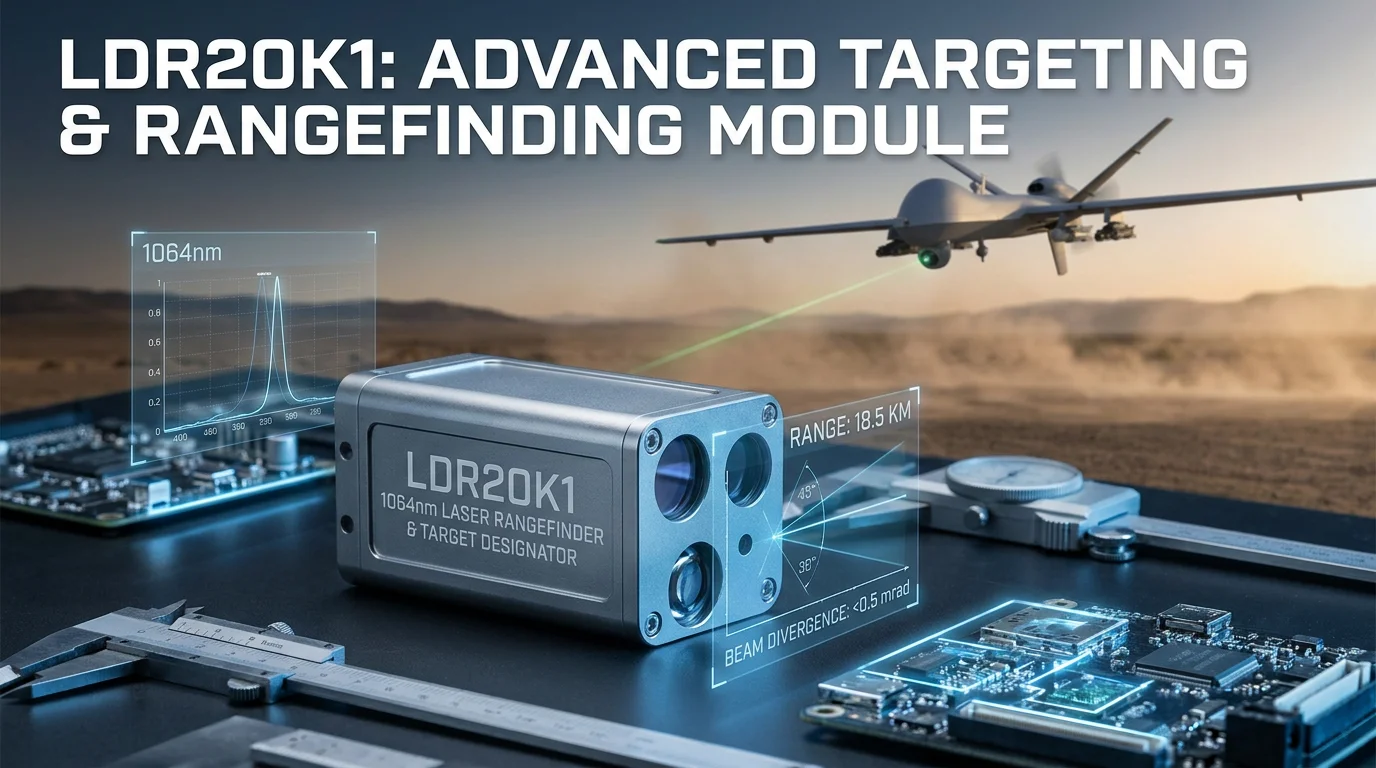
The LDR20K1 utilizes a solid-state 1064nm laser source, a wavelength standard in military and aerospace targeting systems. Unlike traditional diode-based ranging sensors, the LDR20K1’s 1064nm emission provides high energy density and superior beam quality, facilitating effective target designation for semi-active laser (SAL) seekers.
2. Technical Performance & Beam Dynamics
A critical metric for airborne laser systems is beam divergence. The LDR20K1 achieves a beam divergence of ≤ 0.6 mrad, ensuring that the laser spot remains concentrated over multi-kilometer distances. This high beam quality is essential for minimizing the "spot size" on the target, thereby increasing the accuracy of autonomous terminal guidance systems.
Table 1: Technical Specifications of the LDR20K1
| Parameter | Technical Specification |
|---|---|
| Laser Wavelength | 1064 nm ± 1 nm |
| Effective Ranging Range | 300 m – ≥ 3,000 m (Typical) |
| Ranging Accuracy | ± 1 m |
| Designation Frequency | 20 Hz (Fundamental) |
| Beam Divergence | ≤ 0.6 mrad |
| Operational Weight | ≤ 290 g |
| Interface Protocol | RS-422 Digital |
| Dimensions | 92 mm × 67 mm × 53 mm |
| Environment Qualification | MIL-STD-810G compliant (shock/vibration) |
3. UAV Integration: SWaP Optimization
The LDR20K1 is engineered for the stringent constraints of micro-gimbals and EO/IR pods. Weighing less than 290g, it allows for the deployment of advanced targeting capabilities on Class I and Class II UAVs. The compact volume (92mm length) ensures that internal aircraft aerodynamics and payload balance are not compromised.
4. Operational Stability in Harsh Environments
UAV operations often subject payloads to extreme thermal gradients and high-frequency vibrations. The LDR20K1 incorporates an advanced thermal management system and ruggedized internal optics, ensuring that the alignment between the ranging and designation axes remains stable from -40°C to +60°C. This robustness is critical for mission success in both high-altitude reconnaissance and low-altitude tactical maneuvers.
5. Conclusion
As UAV systems move toward increased autonomy and precision, the demand for lightweight, high-performance laser modules continues to accelerate. The LDR20K1 addresses these needs by combining a high-repetition-rate designation capability with surgical ranging accuracy, all within a SWaP-optimized package. For system integrators looking to push the boundaries of drone-based targeting, the LDR20K1 provides a reliable, field-proven foundation.
Interested in integrating the LDR20K1 into your platform?
For technical datasheets, CAD models, or volume pricing, please contact our technical engineering team.
Yilin
ERDI Tech Team
sales@erdicn.com
https://erdicn.com
🔗 Product Page: LDR20K1 Laser Target Designator
Keywords: #TargetDesignator #LaserRangefinder #UAVIntegration #1064nm #DefenseOptronics #SWaP #ERDITech