
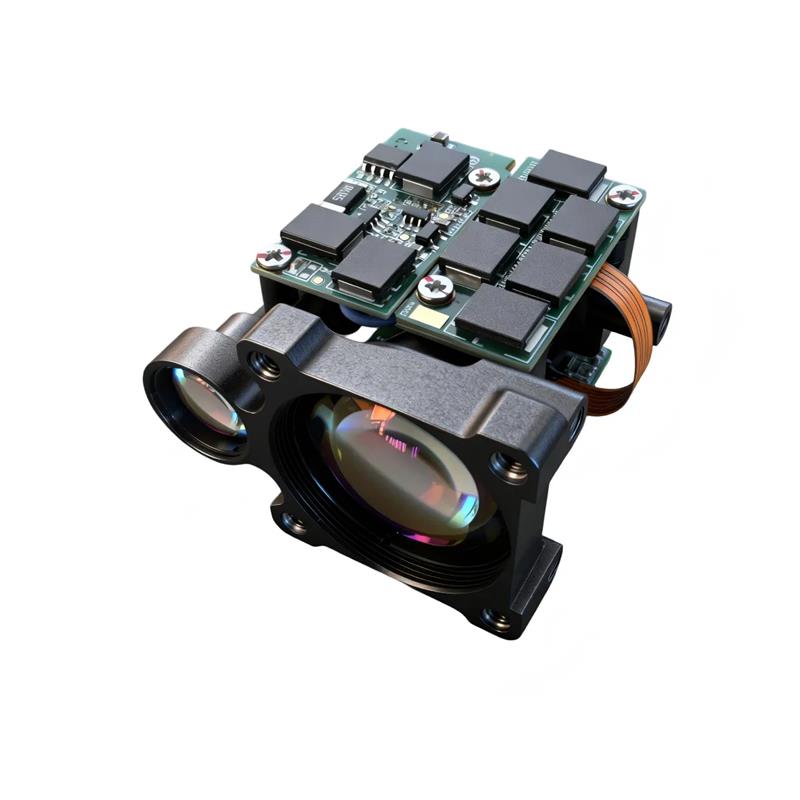
Neodymium-doped yttrium aluminum garnet (Nd:YAG) is a solid-state gain medium widely used in pulsed laser sources. At 1064 nm, a Q-switched Nd:YAG module can produce short, high-peak-power pulses for target designation and time-of-flight range measurement.
The laser source is one part of a complete electro-optical system. Real-world performance depends on the transmitter, beam-expanding optics, receiver, target reflectivity, atmospheric conditions, pointing stability, control electronics, and system-level calibration.
Why 1064 nm Nd:YAG is used
Nd:YAG is a mature laser medium with good mechanical strength, useful thermal properties, and established optical coatings and components. Pulsed 1064 nm sources can be engineered for stable pulse energy and repeatable timing across a defined operating range. Because 1064 nm radiation is invisible and is not inherently eye-safe, the completed system requires rigorous laser-safety controls.
Target designation requirements
A target designator transmits a controlled pulse train that a compatible receiver or seeker can identify. System designers should define pulse energy, pulse width, pulse repetition frequency, coding format, timing jitter, beam divergence, pointing accuracy, and boresight stability. These parameters must be matched to the intended receiver and engagement geometry rather than evaluated in isolation.
Time-of-flight range measurement
In a laser rangefinder, the transmitter emits a short pulse and the receiver measures the round-trip travel time of the reflected signal. Usable range depends on more than the laser's nominal pulse energy. The specification should also define target size and reflectivity, receiver aperture, detector sensitivity, optical filtering, background light, visibility, and the required probability of detection.
OEM integration checklist
- Pulse format: pulse energy, pulse width, repetition rate, and allowable duty cycle.
- Timing and control: trigger level, trigger delay, jitter, synchronization, and coding requirements.
- Beam delivery: divergence, beam quality, beam expander, window coating, and clear aperture.
- Mechanical alignment: mounting datums, boresight adjustment, alignment retention, and service access.
- Electrical interface: supply voltage, peak current, grounding, data interface, and fault reporting.
- Thermal design: warm-up time, heat path, temperature limits, and performance at the required duty cycle.
- Environmental requirements: shock, vibration, sealing, contamination control, storage, and operating temperature.
Validation and laser safety
Qualification should combine bench measurements with representative outdoor range tests. Verification normally includes pulse stability, boresight retention, temperature cycling, shock and vibration, electromagnetic compatibility, receiver saturation behavior, and repeatability against defined targets and visibility conditions.
High-peak-power 1064 nm radiation can cause serious eye and skin injury. Appropriate enclosures, interlocks, warning labels, operating procedures, and system-level compliance testing are required. Module specifications alone do not establish the safety or compliance of the finished product.
ERDI TECH LTD 1064 nm laser designator modules are developed for OEM integration. Our engineering team can support trigger-interface definition, beam-expander and optical-window integration, thermal design, and environmental validation for the intended platform.